
Direct answer for buyers
Co-branded Mahjong sets can increase both price ceiling and store traffic when the collaboration is treated as a product launch rather than only a packaging exercise.
The strongest programs pair the right artist, a clear licensing structure, a manageable first production run, and a launch plan that turns the artist's audience into in-store visitors.
Key takeaways
- Co-branded Mahjong sets can increase both price ceiling and store traffic when the collaboration is treated as a product launch rather than only a packaging exercise.
- The strongest programs pair the right artist, a clear licensing structure, a manageable first production run, and a launch plan that turns the artist's audience into in-store visitors.
- The American Mahjong market sits at a useful commercial overlap: gaming, gifting, and collectible design.
On this page
- The Intersection of Art, Games, and Retail Revenue
- Why Artist Collaborations Work for Mahjong Specifically
- Structuring the Collaboration
- The Production Process: From Concept to Shelf
- Marketing the Collaboration for Maximum Foot Traffic
- Managing Intellectual Property and Contracts
- Three Questions About Artist Collaborations
- Sources & References
- Buyer checklist
- Production notes
- Related buyer guides
The Intersection of Art, Games, and Retail Revenue
The American Mahjong market sits at a useful commercial overlap: gaming, gifting, and collectible design. The source article cites a 2025 global Mahjong market value of USD 2.8 billion with projected growth to USD 5.2 billion by 2034, while the broader personalized gifts market is cited at USD 30.79 billion in 2025 with continued expansion ahead. A co-branded artist set lives directly inside that overlap.
For boutique retailers, the economics are often stronger than a standard private label launch. A conventional American Mahjong set might retail at roughly USD 150 to 250. An artist-collaboration edition can often justify USD 300 to 500 because the customer is buying both a playable set and an art object with scarcity value.
The traffic upside matters just as much as the higher ticket. An artist partnership introduces your store to the artist's existing audience, which means the launch can create visits from people who may not have found the shop through normal retail channels.
When the collaboration has a real story, the store is no longer selling only product inventory. It is selling access, community, collectibility, and a reason to visit now instead of later.
Why Artist Collaborations Work for Mahjong Specifically
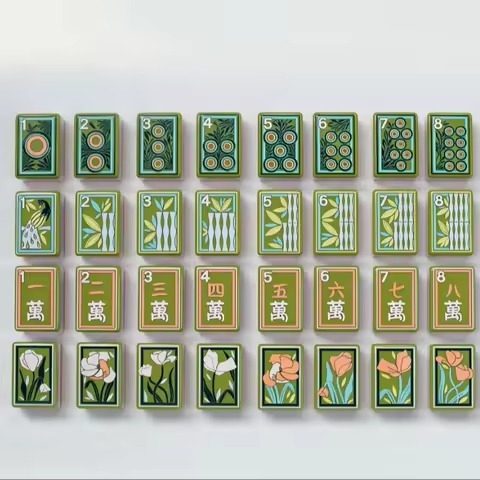
Mahjong tiles are unusually well suited to artistic reinterpretation. A complete set includes 152 to 166 pieces, which creates enough repeated surfaces for a visual language to feel expansive and collectible. At the same time, the functional categories are already defined: Craks, Bams, Dots, Winds, Dragons, Flowers, and Jokers.
That built-in structure helps artists rather than limiting them. The design system must stay playable, but the repeated categories give the artist room to translate motifs, palettes, typography, and illustration into a coherent set. The result is more differentiated than a standard print or poster because the object is meant to be displayed, handled, and used socially.
The demographic overlap is also favorable. The source article notes that the core American Mahjong buyer often overlaps with shoppers who support local artists, attend events, and buy design-led home or gift products. That makes Mahjong collaborations especially effective for boutiques, gallery-adjacent shops, and lifestyle retailers.
Structuring the Collaboration
| Model | How it works | Best fit |
|---|---|---|
| Licensed artwork | The artist licenses existing work for adaptation to Mahjong tile faces and packaging, usually for a flat fee or a modest revenue share. | Retailers who want the fastest path to launch and artists with a recognizable visual style already proven in prints or surface design. |
| Commissioned original design | The artist creates a purpose-built Mahjong system, often with an upfront design fee plus a smaller royalty on each set sold. | Brands that want a more defensible, cohesive collection and are willing to invest more time in revision and sampling. |
| Revenue-share partnership | The artist contributes more of the creative work without a large upfront fee in exchange for a higher share of sales. | Emerging artists with strong engagement and boutiques that want to share launch risk rather than fund the entire collaboration alone. |
The right structure depends on both cash flow and audience leverage. If the artist brings a meaningful local following, a royalty or revenue-share model can make sense. If the retailer needs more control over schedule and deliverables, a commissioned structure is usually easier to manage.
The Production Process: From Concept to Shelf
A successful collaboration still has to behave like a real manufacturing project. The design must work at actual tile scale, remain readable under indoor lighting, and survive the technical translation from artwork into engraved or printed production files.
- Creative brief and concept alignment. Define the theme, palette, tile system, packaging direction, and playability constraints before artwork starts.
- Drafting and revision. Start with high-flexibility categories like Flowers and Jokers, then resolve the more functional suits where readability matters most.
- Factory file preparation. Convert approved artwork into production-ready layouts sized for tile faces, inserts, and packaging components.
- Sample production and review. Evaluate a complete physical sample for color accuracy, engraving depth, tactile feel, and whether the artwork still reads clearly during actual play.
- Bulk production, inspection, and shipping. Approve the final sample, run QC against that reference, then ship on a timeline that still supports the launch event and pre-order promises.
The sample step is non-negotiable. Tile surfaces, translucency, and engraving can look different in real acrylic than they do on screen. A collaboration that photographs well but plays poorly will not create repeat demand.
Lucky Mahjong can help turn artwork concepts into production-ready specs, tile sampling steps, packaging plans, and realistic first-run quantities.
Request a Wholesale QuoteMarketing the Collaboration for Maximum Foot Traffic
The launch plan is what turns a design collaboration into a traffic engine. An in-store event with the artist present usually performs best because it gives both audiences a physical reason to show up, interact, and post about the product. A Mahjong demonstration, refreshments, and a simple photo-friendly display can make the event itself part of the campaign.
Numbered editions also help. If the first run is clearly limited, the retailer gains a scarcity story that supports premium pricing and earlier purchase decisions. The source article recommends using pre-orders three to four weeks before launch to validate demand and create momentum before inventory arrives.
Cross-promotion is the mechanism that multiplies traffic. The artist can activate Instagram followers, local contacts, newsletter readers, or gallery visitors. The retailer can activate existing customers, in-store visitors, and local lifestyle press. When both sides are promoting to different but compatible audiences, the collaboration reaches people neither side would have reached alone.
Managing Intellectual Property and Contracts
Every collaboration needs a written agreement before the artwork is adapted for production. At minimum, the contract should define who owns the original art, who has the right to reproduce it in Mahjong format, whether the license is exclusive, how long the exclusivity lasts, what geographic markets are covered, and how royalties are calculated and reported.
Typography and embedded design assets also need attention. If the set uses decorative fonts, stock illustration components, or borrowed pattern elements, those rights should be cleared for commercial product reproduction, not only digital or editorial use. This is a common place where small collaboration projects become legally messy later.
Approval rights matter too. If the factory needs to simplify linework, alter color fills, or adjust layout for tile geometry, the agreement should already define whether the artist must approve those changes and how quickly that approval should happen.
Three Questions About Artist Collaborations
What is the ideal production quantity for a first artist collaboration?
For most boutique retailers, 200 to 300 sets is a practical first run. It is usually enough to improve unit economics without creating too much inventory risk, and it still supports a credible limited-edition story.
How do I find the right artist for a Mahjong collaboration?
Start locally with illustrators, pattern designers, and surface artists whose audience overlaps with your target buyer. The most useful signals are distinctive style, engaged followers, reliable communication, and some evidence that the artist can work within product constraints.
Can I collaborate with multiple artists simultaneously for a collection?
Yes, but it works better when launches are staggered. A collection can create a stronger collector dynamic, but it also multiplies sample rounds, production tracking, royalty accounting, and launch coordination.
Related planning resources include the IP and typography licensing guide, the brand launch roadmap, and the sample ordering checklist.
Sources & References
- DataIntelo Market Research: Global Mahjong Market Report 2025-2034
- The Business Research Company: Personalized Gifts Global Market Report 2025
- National Mah Jongg League
- SkyQuest Technology: Board Games Market Size & Growth Analysis
Buyer checklist
- Check ownership and licenses for artwork, fonts and reference images.
- Confirm face, back and joker files against the tile manifest.
- Approve a physical proof for scale, legibility and color before bulk production.
Production notes
Artwork guidance is a preparation aid. Minimum line widths, color matching and marking methods depend on the material and approved sample.
Continue your project planning
For a project review, see Custom Mahjong tiles. The cluster overview connects this decision with the rest of the sourcing process.
Planning a custom set?
Send quantity, tile count, target dimensions, artwork status, accessories, packaging, destination and launch date. These details help define a comparable quotation and sample scope.
Discuss a custom project