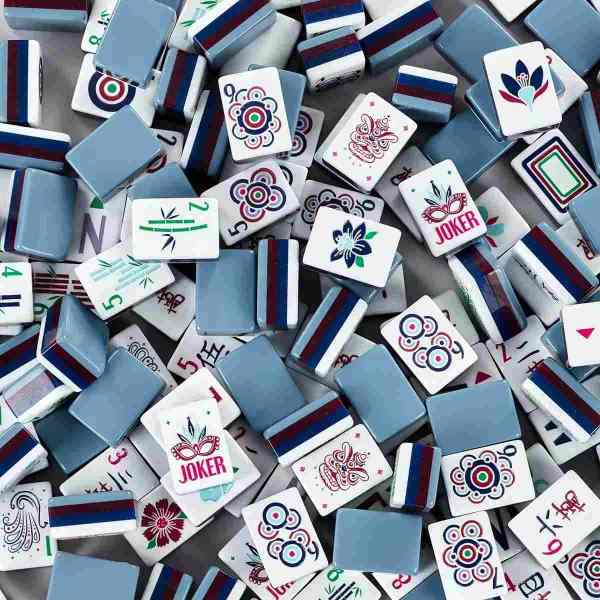
The most lightweight American Mahjong sets suitable for travel weigh between 4 and 7 pounds total, compared to standard sets that typically range from 10 to 15 pounds. If you are looking for a portable American Mahjong set that you can easily carry to a friend's house, pack in your suitcase for a vacation, or bring to a Mahjong cruise, you want a set that balances reduced weight with playable tile size and durability.
The short answer: mini-format American Mahjong sets with smaller tiles (around 0.8 inches tall) in soft carrying cases are your best bet for travel. They deliver the full 152-tile American Mahjong experience in a package that fits in a backpack or carry-on bag.
Why Weight Matters for Mahjong Players
American Mahjong is inherently a social game. Unlike solitaire card games or smartphone apps, you need the physical tiles, racks, and accessories spread across a table to play properly. Most active players do not play exclusively at home. They rotate between homes, meet at community centers, join Mahjong groups at clubs, or take their sets on vacation and cruises. All of these scenarios require transporting the set.
A standard full-size American Mahjong set with large 1.2-inch tiles, four heavy wooden or thick plastic racks, pushers, dice, and a hard-shell case can weigh 12 to 15 pounds. That is comparable to carrying a bowling ball. For a short walk to a neighbor's house, it is manageable. For anything beyond that — a subway ride, a flight, a cruise ship cabin — it becomes a burden.
This is why lightweight travel sets exist. They use smaller tiles, lighter rack materials, and compact packaging to reduce the total carry weight to a fraction of the standard set.
Key Factors in a Lightweight Travel Set
Several design choices determine how light and portable a Mahjong set can be. Understanding these factors helps you choose the right set for your travel needs.
Tile size is the biggest factor. Standard American Mahjong tiles are approximately 1.2 inches tall by 0.9 inches wide by 0.5 inches thick. Travel sets use tiles that are around 0.8 inches tall by 0.6 inches wide by 0.4 inches thick. This reduction in each dimension dramatically cuts the total weight of 152 tiles. The trade-off is that smaller tiles are slightly harder to read, especially for players with vision challenges, but most players adapt quickly.
Tile material also matters. Traditional tiles are made from dense resin or bone-and-bamboo composites. Travel sets often use lighter-weight ABS plastic or acrylic. Modern manufacturing techniques produce lightweight tiles that still have a satisfying feel and clear, durable engraving. The key is to avoid extremely cheap plastic tiles that feel flimsy and have painted rather than engraved markings — the paint will wear off with regular play.
Rack design contributes significantly to total weight. Standard racks are made from thick, rigid plastic or wood. Travel-friendly sets may include lightweight acrylic racks, foldable racks, or even skip racks entirely in favor of a flat playing surface with a simple tile holder. Some travel sets use stacking racks that nest together when packed, reducing both weight and bulk.
The carrying case is the final weight variable. Hard-shell aluminum cases look impressive but add 2 to 3 pounds to the total. Soft cases made from nylon or polyester with zipper closures weigh under a pound and can compress to fit into tight spaces like a suitcase corner or a tote bag.
Recommended Weight Categories for Travel Sets
Based on the most common travel scenarios, here are the weight ranges that work best.
Under 5 pounds: Ultra-light sets suitable for air travel carry-on. These typically have the smallest tiles and minimal accessories. They are perfect for Mahjong cruises and vacations where you want to play in your cabin or at the ship's game room. The trade-off is a slightly diminished tactile experience compared to full-size tiles.
5 to 7 pounds: The sweet spot for most travelers. These sets have mid-size tiles that are comfortable to handle, basic racks, and a soft carrying case. They are light enough to carry on public transit or pack in checked luggage without dominating your weight allowance. You can check detailed specifications on specialized US Mahjong guides like lukmaj.com to compare models in this weight class.
7 to 10 pounds: Semi-portable sets that bridge the gap between travel and home use. These often have full-size or near-full-size tiles but use lighter rack materials and a soft case instead of a hard-shell box. They are ideal for players who primarily drive to their game locations and want a set that feels close to standard while still being portable.
Beyond 10 pounds: These are standard home sets that happen to have a carrying handle. They are not ideal for travel beyond short car trips.
How to Pack a Mahjong Set for Travel
Even with a lightweight set, how you pack it makes a difference. Here are practical tips from experienced traveling Mahjong players.
Pack tiles in their original tray or a dedicated tile bag to prevent scratching. Tiles rubbing against each other in a loose bag will gradually dull the engraved surfaces.
If your travel set has foldable racks, secure them with a rubber band or Velcro strap so they do not pop open inside your luggage. An unexpected rack opening can damage the rack hinges or crack a tile.
Place the NMJL card in a rigid sleeve or between two pieces of cardboard to prevent bending. A creased card is hard to read and looks unprofessional at group games.
If you are flying, consider whether to carry the set on or check it. A lightweight set under 5 pounds in a soft case fits easily in an overhead bin. Checked bags risk rough handling, but a well-padded set inside your suitcase surrounded by clothing usually survives fine.
Consider leaving the pushers at home for travel games. Pushers are nice but not essential, and skipping them saves weight and bulk. Most casual travel games are played without pushers anyway.
Durability Concerns with Lightweight Sets
The biggest worry players have about travel sets is durability. Will lightweight tiles chip? Will thin racks crack? Will the case fall apart after a few trips?
The honest answer is that travel sets do trade some durability for portability. But the best travel sets from reputable manufacturers are designed to withstand regular use. Look for these durability indicators.
Engraved tile markings rather than painted or stickered ones. Engraving does not wear off. If you can feel the marking with your fingernail, it is engraved. If it is perfectly smooth, it is likely printed and will degrade over time.
Solid-feeling tiles with some weight to them, even if they are smaller. Tiles that feel hollow or paper-light are more likely to crack when dropped or knocked off a table.
Racks with reinforced stress points. The weakest part of any rack is the pusher track and the joint where the rack walls meet the base. Good travel racks have thicker material at these points.
A case with decent padding. Even a soft case should have some foam or padding between the tile trays and the outside wall. This protects tiles from impact during transport.
Playing with a Travel Set: What to Expect
If you are accustomed to playing with a full-size, heavy-tile American Mahjong set, switching to a travel set requires a brief adjustment period.
The smaller tiles are the most noticeable difference. Building a wall of 19 tiles per player looks and feels different with smaller pieces. The wall is shorter and less dramatic. Drawing and discarding tiles requires a lighter touch because the tiles are easier to knock over.
Reading the tiles takes more concentration initially, especially distinguishing between similar-looking numbers in the crack and bam suits. Most players fully adjust within two or three game sessions.
The tactile feedback is different. Full-size tiles have a satisfying weight and clack when you place them on the table. Smaller, lighter tiles produce a higher-pitched sound and less dramatic feel. This does not affect gameplay at all, but some players find they miss the sensory experience of heavier tiles.
Despite these differences, the gameplay itself is identical. You still have 152 tiles, the same suits, the same jokers, the same hands on the NMJL card. The strategy, the Charleston, the declarations — everything plays exactly the same way. A travel set gives you the complete American Mahjong experience in a portable package.
When a Travel Set Is the Wrong Choice
Travel sets are not for everyone. If you play exclusively at home and never transport your set, there is no reason to compromise on tile size or rack quality. A heavy, full-size set with a beautiful hard-shell case is a better investment for home-only play.
If you host regular games at your house and want a set that makes an impression when guests arrive, a standard or premium set is more appropriate. Travel sets prioritize function over aesthetics.
If you have significant vision challenges or arthritis in your hands, the smaller tiles of a travel set may be uncomfortable or difficult to use. In these cases, a full-size set is the better choice even if you need to transport it occasionally.
FAQ
Can I use a travel American Mahjong set in an NMJL tournament?
According to NMJL standard tournament guidelines, there is no specific restriction on tile size, but all 152 standard tiles must be present and clearly readable. Most tournament players use full-size sets for comfort and readability during long sessions. If you are considering using a travel set in a tournament, check with the specific tournament organizer beforehand.
What is the lightest American Mahjong set available?
The lightest sets weigh approximately 3.5 to 4 pounds. These ultra-compact sets use the smallest tiles and minimal accessories. They are best suited for occasional travel play rather than regular weekly games.
Are travel Mahjong sets cheaper than standard sets?
Generally yes. Travel sets typically cost between $40 and $80, while standard full-size sets range from $80 to $250. The lower price reflects smaller tiles, simpler packaging, and fewer included accessories.
Can I take a Mahjong set on an airplane?
Yes. Mahjong tiles contain no prohibited materials. A lightweight set in a soft case can be carried on as a personal item or packed in checked luggage. Be aware that a full-size set in a hard-shell case may exceed airline weight limits for carry-on bags on smaller aircraft.
How long do travel Mahjong sets last?
A well-made travel set with engraved tiles and decent rack construction can last for years of regular play. The most common failure point is the carrying case, which may wear out before the tiles do. Replacing a soft case is inexpensive and straightforward.