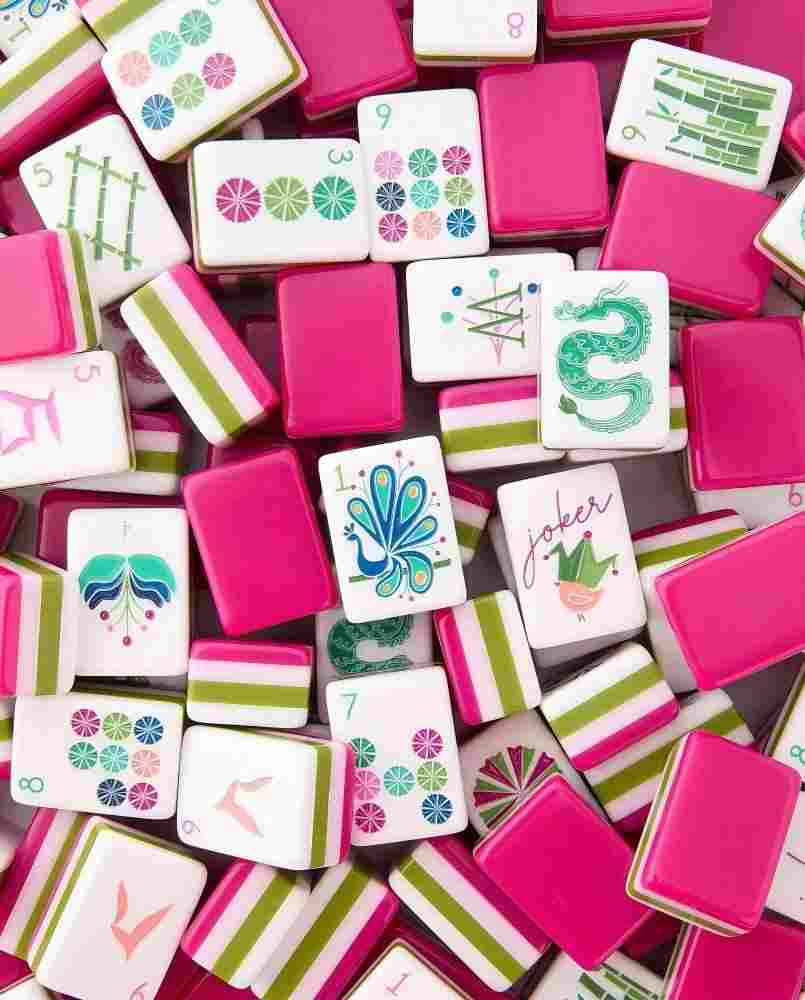
The difference between American Mahjong and Chinese Mahjong sets comes down to tile count, the presence of jokers, the use of racks, and the rule systems governing gameplay. American Mahjong uses 166 tiles including 8 jokers, requires racks for each player, and follows rules set by the National Mah Jongg League. Chinese Mahjong uses 144 tiles, has no jokers, is played without racks, and follows one of several regional rule variants common across China and Southeast Asia.
Understanding these differences matters because buying the wrong type of set means you cannot play the version of the game you intend to learn. This guide explains every distinction in detail so you can make an informed purchase.
The Origins: Two Games, One Ancestor
Mahjong originated in China during the Qing Dynasty, likely in the mid-1800s. The game spread internationally in the early 20th century, reaching the United States in the 1920s. American Mahjong evolved from the Chinese original but diverged significantly over the decades. The National Mah Jongg League was founded in 1937 to standardize American rules, publish an annual card of valid hands, and organize tournament play.
Today, American Mahjong and Chinese Mahjong are related but distinct games. They share the same basic tile types and the same fundamental mechanic of drawing and discarding tiles to form winning combinations. Beyond that core, almost everything differs.
Tile Count: 166 vs 144
The most immediately visible difference is the number of tiles in the box.
American Mahjong sets contain 166 tiles. According to NMJL standard tournament guidelines, this includes all suits, honors, flowers, and 8 joker tiles plus blank spares. The jokers are a uniquely American addition and are critical to gameplay because they can substitute for any tile in certain hands.
Chinese Mahjong sets contain 144 tiles. This includes the three suits, the four wind tiles, the three dragon tiles, and flower and season bonus tiles. There are no jokers. The flower and season tiles serve a different function than jokers, providing bonus points rather than acting as wild cards.
Some Chinese sets include extra blank tiles for replacements, bringing the total to 148, but these are not used in the same way as American jokers.
Tile Markings: Dual Language vs Chinese Only
American Mahjong tiles feature dual markings. Each tile displays the traditional Chinese character alongside an English equivalent. Bamboo tiles show the number in Arabic numerals. Wind tiles display N, S, E, or W. Dragon tiles show R, G, or B. This dual marking system was designed for American players who do not read Chinese characters.
Chinese Mahjong tiles typically display only Chinese characters and numerals. The bamboo suit uses dots, the character suit uses Chinese numerals, and the circle suit uses the traditional circle patterns. There are no English letters or Arabic numerals on most Chinese sets.
This difference in markings is the reason many American beginners cannot play with a Chinese set. Without the English translations, identifying tiles quickly enough for gameplay becomes extremely difficult for non-Chinese readers.
Jokers: The Defining Difference
The presence of 8 joker tiles is the single most important distinction between American and Chinese Mahjong sets. Jokers function as wild cards in American Mahjong. They can replace any tile in specific hands listed on the annual NMJL card. This dramatically changes strategy because it opens up many more possible winning combinations.
Chinese Mahjong has no jokers. Every tile in your hand must be the exact tile required. This makes Chinese Mahjong more rigid in terms of hand construction but also changes the strategic balance. In Chinese Mahjong, you cannot rely on wild cards to complete a hand, so reading the discard pile and tracking which tiles have been played becomes even more critical.
Racks and Pushers vs Flat Play
American Mahjong is played with racks. Each player has a wooden or plastic rack that holds 19 tiles upright, facing only the player. This keeps your hand private from opponents sitting on either side of you. Most modern American sets also include pushers, which are sliding attachments that help players build the wall of tiles without exposing them.
Chinese Mahjong is played flat. Tiles are held in the player's hand or arranged face-down on the table in front of the player. There are no racks. This flat arrangement is traditional and works well in Chinese gameplay, which typically involves four players seated closely around a square table.
The use of racks is so fundamental to American Mahjong that the NMJL rules explicitly require them in tournament play. A Chinese Mahjong set will not include racks because they are not part of the Chinese game.
Flowers and Seasons: Different Functions
Both American and Chinese Mahjong sets include flower tiles, but they function differently.
In American Mahjong, the flower tiles are part of the standard tile set and are used in certain hands listed on the NMJL card. There are typically 8 flower tiles in an American set, often depicting the four seasons and four flowers in pairs.
In Chinese Mahjong, flower and season tiles are bonus tiles. When drawn, they are immediately revealed and set aside, and the player draws a replacement tile. They contribute bonus points at the end of the round but are not part of the hand itself.
The Annual Card: Unique to American Mahjong
American Mahjong uses an annual card published by the National Mah Jongg League that lists all valid hands for the current year. This card changes every year, which means the game evolves annually. Players must purchase a new card each year and learn the updated hand combinations.
Chinese Mahjong has no equivalent annual card. The valid hands and scoring are based on long-standing traditional patterns that do not change from year to year. Regional variants like Hong Kong Mahjong, Sichuan Mahjong, and Taiwanese Mahjong each have their own established rules.
This annual card system is unique to American Mahjong and is one of the reasons the game has such an active community. The yearly refresh keeps gameplay interesting and creates opportunities for new strategies.
Scoring: Simplicity vs Complexity
American Mahjong scoring is relatively straightforward. The NMJL card assigns a specific value to each hand, typically ranging from 25 to 75 points. The winning player collects that amount from each opponent. There is no complex point system for individual tile combinations within a hand.
Chinese Mahjong scoring can be significantly more complex, especially in tournament settings. Points are calculated based on fan or han values assigned to specific patterns and combinations. Different regional systems have different scoring tables, and some include penalty and bonus calculations that can make scoring a lengthy process.
For beginners, American Mahjong's simpler scoring system is generally easier to learn. The fixed values on the NMJL card remove the need to memorize complex point tables.
Gameplay Speed and Style
Chinese Mahjong is typically faster paced. Hands are completed more quickly because there are no jokers to extend possibilities, and the rules encourage aggressive play. A typical Chinese Mahjong hand might last 5 to 10 minutes.
American Mahjong hands tend to take longer because jokers create more possible combinations and players have more strategic decisions to make. A typical American Mahjong hand might last 10 to 20 minutes.
The social atmosphere also differs. American Mahjong has a strong social tradition in the United States, particularly among women's groups, community centers, and retirement communities. Chinese Mahjong has its own rich social culture, often associated with family gatherings and mahjong parlors in Chinese communities worldwide.
Which Set Should You Buy?
The answer depends entirely on which version of the game you want to play. If you live in the United States and want to play with American groups, clubs, or NMJL-affiliated teachers, buy an American Mahjong set with 166 tiles, jokers, racks, and English markings.
If you want to play the traditional Chinese version with Chinese-speaking friends or family, or if you are interested in competitive play following Chinese tournament rules, buy a Chinese Mahjong set with 144 tiles.
Never assume one set works for both games. The tile configurations are fundamentally incompatible. You can browse specifications for different American Mahjong sets on sites like lukmaj.com to find the right set for your needs.
Can You Modify a Chinese Set for American Play?
Technically, some players try to add joker tiles to a Chinese set to play American Mahjong. This does not work well in practice. The tiles will not match in size, color, or style. The lack of English markings makes gameplay difficult for American players. And most importantly, you would still need to obtain racks separately.
The effort and cost of modifying a Chinese set to approximate American Mahjong exceeds the cost of simply buying a proper American Mahjong set. Save yourself the frustration and buy the correct set from the start.
Frequently Asked Questions
Are American Mahjong and Chinese Mahjong tiles the same size?
Not necessarily. American Mahjong tiles tend to be larger, especially jumbo tiles designed for the US market. Chinese Mahjong tiles vary more in size depending on the region and manufacturer. The standard American jumbo tile is approximately 36mm tall, while Chinese tiles typically range from 28mm to 33mm.
Can I use an American Mahjong set to play Chinese Mahjong?
Partially. You can remove the jokers and play a simplified version of Chinese Mahjong, but the set will still have English markings and may include more flower tiles than a standard Chinese set. It works for casual play but not for strict Chinese tournament rules.
Why does American Mahjong have jokers?
Jokers were introduced to American Mahjong in the 1930s as part of the rule changes made by the National Mah Jongg League. They add strategic variety and make the game more accessible to new players by providing additional flexibility in forming valid hands.
How do I know if a set is American or Chinese before buying?
Check the tile count and the presence of jokers. A 166-tile set with 8 jokers and English markings is American. A 144-tile set without jokers and with only Chinese characters is Chinese. The listing or packaging should clearly state which version the set is designed for.
Is one version of Mahjong easier to learn than the other?
Most American players find American Mahjong easier to learn initially because of the dual-language tiles, the structured NMJL card, and the simpler scoring system. Chinese Mahjong has fewer special tiles but requires familiarity with Chinese characters and more complex scoring.