
Direct answer
This glossary explains common American Mahjong terms in plain English so buyers, product teams and store staff can talk confidently with customers. It covers the tiles, the equipment and a few gameplay words customers often ask about. For full rules, players use the annual card published by the National Mah Jongg League.
Key takeaways
- The three numbered suits in an American Mahjong set.
- The rack holds tiles; the pusher attaches to the rack and moves the wall.
- Extra tiles beyond the 152-tile core may be jokers, blanks or spares depending on the set.
On this page
Tiles
- Suits: the three numbered suits, usually called Bams (bamboos), Craks (characters) and Dots (circles), each numbered 1 to 9.
- Winds: North, East, West and South tiles.
- Dragons: three dragons, each linked to a suit. The white dragon is sometimes called Soap.
- Flowers: eight decorative tiles in a standard American set; see flower tile design.
- Jokers: eight wild tiles in a standard American set; see joker design.
- Blanks: extra tiles with no face, included in some sets.
- 152, 160, 166: common total tile counts. The 152-tile core includes eight jokers; see tile count explained.
Equipment
- Rack: the stand that holds a player's tiles.
- Pusher: the arm attached to a rack, used to push the wall forward; see pusher anatomy.
- Card holder: a stand for the annual card.
- Mat: a table covering that softens noise and protects the table.
- Dice: rolled during setup.
- Wind indicator: shows which player is East; see dice and wind indicators.
Gameplay words customers mention
- The card: the annual list of winning hands published by the National Mah Jongg League, bought separately.
- Charleston: the passing of tiles between players before play starts; see the Charleston explained.
- Wall: the rows of face-down tiles built at the start.
- East: the dealer for the hand.
- Pung, Kong, Quint: groups of three, four and five identical tiles (quints use jokers).
- Exposure: a group of tiles placed face up on the rack after calling a discard.
- Mahjong (Mah Jongg): declaring a winning hand.
Product words
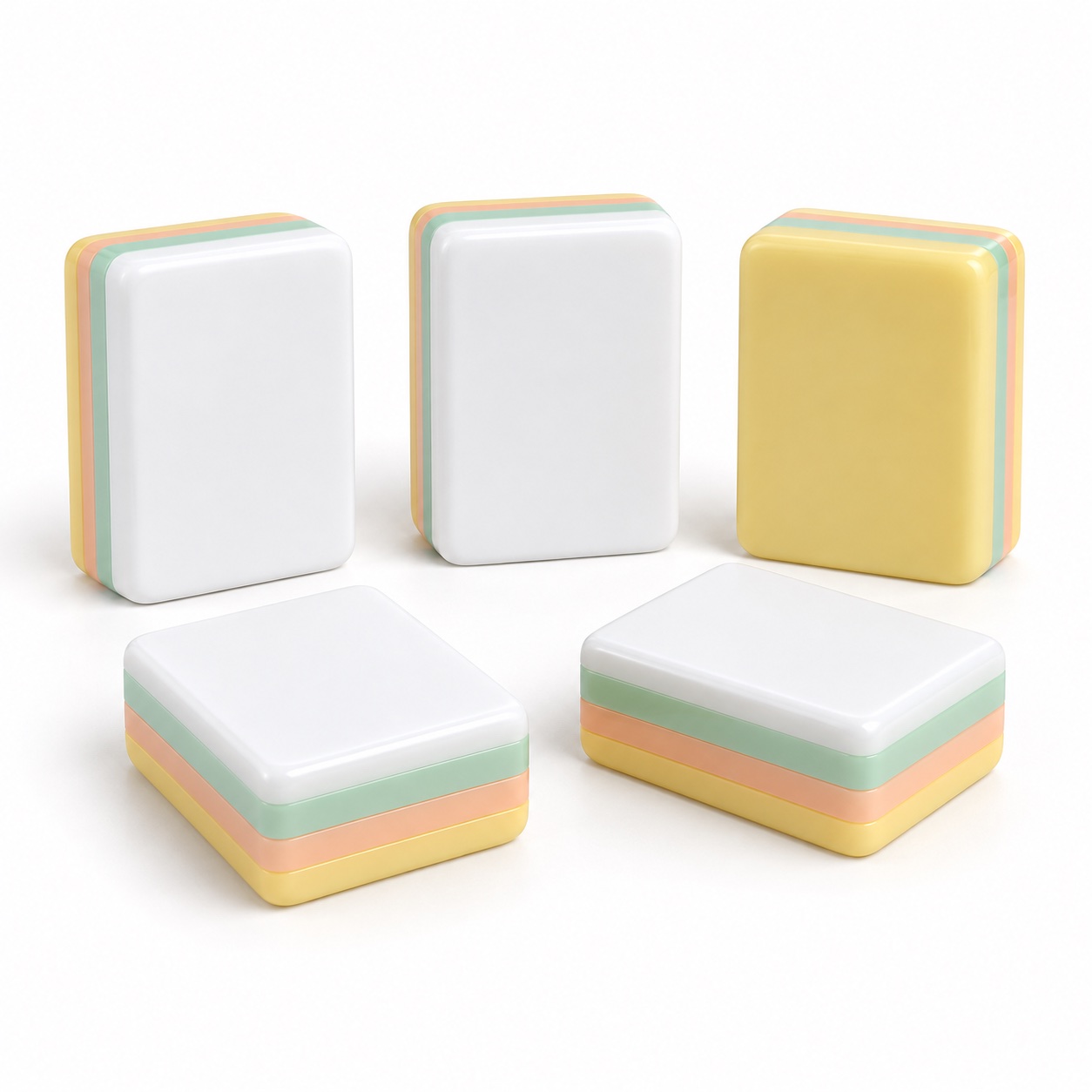
- Two-tone or multilayer tiles: tiles made from bonded acrylic layers; see layer options.
- Engraved and color-filled: markings cut into the tile and filled with color.
- Lucite: a trade name for acrylic; see Lucite vs acrylic.
FAQ
What are Bams, Craks and Dots?
The three numbered suits in an American Mahjong set.
Is the card included with a set?
Usually not. Players buy the annual card separately.
What is the difference between a rack and a pusher?
The rack holds tiles; the pusher attaches to the rack and moves the wall.
Why do sets have different tile counts?
Extra tiles beyond the 152-tile core may be jokers, blanks or spares depending on the set.
Next step
Training staff or writing product pages? Send Lucky Mahjong your set details and we will confirm the components and tile counts for your descriptions.
See American Mahjong products →
Buyer checklist
- Define the first buyer, sales channel and collection scope.
- Budget samples, artwork, inventory, packaging and delivery separately.
- Record sample approval, launch timing and reorder version control.
Production notes
Launch examples are planning guidance, not sales forecasts or fixed commercial terms. Confirm the product scope and approval milestones before making commitments.
Continue your project planning
For a project review, see /products. The cluster overview connects this decision with the rest of the sourcing process.
Planning a custom set?
Send quantity, tile count, target dimensions, artwork status, accessories, packaging, destination and launch date. These details help define a comparable quotation and sample scope.
Discuss a custom project