
Direct answer
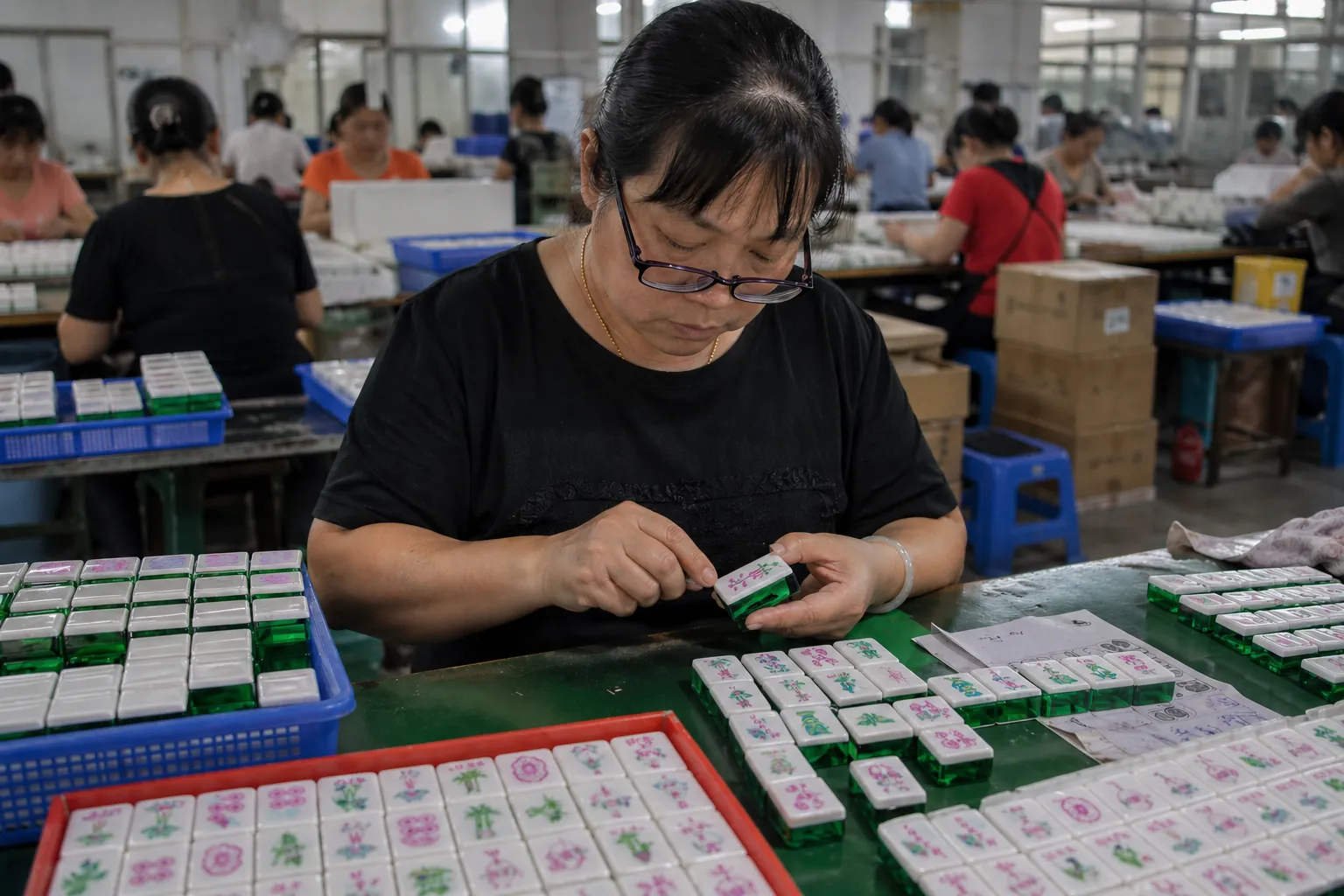
A factory operates at least some of the production processes itself; a trading company sells and coordinates goods produced by others. In Mahjong sourcing the line is often blurred: a set combines tiles, marking, racks, pushers, mats, bags and printed packaging, and few single sites make every component. The useful question is not "factory or trader?" but "who performs each process, who is accountable for the complete set, and can I see evidence for my project?" Verify the legal entity, ask which operations are in-house, request project-specific process evidence, and write down which party owns quality and corrective action.
Key takeaways
- A factory operates at least some of the production processes itself; a trading company sells and coordinates goods produced by others.
- Start with who you are contracting with and paying.
- A note on Lucky Mahjong: we are an integrated manufacturing and trading business.
On this page
- Key takeaways
- Legal identity is different from production location
- The third model: integrated manufacturer-traders
- Ask which operations are in-house
- Request project-specific process evidence
- Identify specialist partner responsibilities
- Compare communication and inspection access
- Record accountable supplier and handoff
- Common mistakes and buyer checklist
- FAQ
- Next step: send a defined project brief
- Buyer checklist
- Production notes
- Related buyer guides
Key takeaways
- A company name does not prove where products are made. Legal identity and production location are separate facts.
- Ask process by process. Tile cutting, marking, assembly, accessories and packaging may each happen in different places.
- Project evidence beats general photos. Ask for photos or video of your sample in production, not a showroom.
- Partners are normal; hidden partners are the risk. Specialist suppliers for boxes or mats are common. You need to know who they are responsible to.
- One accountable party. Whatever the structure, one contracting party should own complete-set quality and fixes.
Legal identity is different from production location
Start with who you are contracting with and paying.
- Check that the legal company name is the same on the quotation, proforma invoice, contract and bank beneficiary.
- Review the business registration through appropriate current sources. In China, a registered business scope may mention manufacturing, trading or both, but scope alone does not prove that machines are operated on site.
- A name containing "Trading" does not mean the company has no production involvement, and a name containing "Factory" or "Manufacturing" does not prove that every process is in-house.
A note on Lucky Mahjong: we are an integrated manufacturing and trading business. Our production and our export trading entity, Shenzhen Nuolanxiang Trading Co., Ltd. in Shenzhen, China, work as one supplier. Some components in a complete set, such as printed packaging or textiles, may come from specialist suppliers we manage. For each project we tell buyers which steps happen in our production, which components come from partners, and who is accountable for the complete set, in writing.
The third model: integrated manufacturer-traders
Many Chinese suppliers are neither a pure factory nor a pure trading company. An integrated manufacturer-trader runs its own production and also operates an export trading entity that handles contracts, invoicing and shipping. In China this is often described as a combined "industry and trade" business.
What this means for a buyer:
- The contracting entity may carry "Trading" in its name even though the business has its own production.
- Production and sales sit under one accountable supplier, which can simplify communication and corrective action.
- Some components may still come from specialist partners, especially packaging, mats and bags.
The verification steps below apply in the same way: check the legal entity, ask which operations are in-house for your project, and request project-specific evidence.
Ask which operations are in-house
A custom American Mahjong set typically involves:
- Tile material preparation (acrylic sheet, layered bonding, or melamine molding)
- Cutting and machining to size, edges and finish
- Marking: engraving, color fill, UV printing or a hybrid
- Racks and pushers (often molded or machined components)
- Mats, bags and cases (textile, leather or printed products)
- Retail packaging (rigid boxes, folding cartons, inserts)
- Kitting, inspection and export packing
Ask the supplier to mark each process as in-house, long-term partner or sourced per project, and to name the location. A clear, specific answer, even one listing several partners, is a better sign than a vague "we do everything."
Request project-specific process evidence
General factory photos can belong to anyone. Evidence tied to your project is harder to fake and more useful.
| Evidence request | What it demonstrates | Limits | Follow-up |
|---|---|---|---|
| Photos or video of your sample tiles during marking | The marking process exists and was applied to your artwork | Does not show capacity or bulk consistency | Ask where it was filmed and by whom |
| Live video call walking the production area | Access to a working site | Site may belong to a partner; one call is a snapshot | Ask which processes for your order happen there |
| Process test tiles from your files | Capability on your specific detail | Small quantity may not predict bulk | Tie test results to the sample approval record |
| Material and component list for your sample | Who sources which part | Paper only | Compare against what arrives |
| Third-party inspection report or audit | Independent observation | Scope and date limited; may cover another site | Check the address and date match your production |
| Business registration and invoice details | Legal identity and payment beneficiary | Says nothing about production | Match entity across all documents |
For larger orders, an independent pre-shipment inspection is a common control. See AQL and third-party inspection for custom Mahjong sets.
Identify specialist partner responsibilities
Specialist partners are normal in this category. Rigid gift boxes, printed mats and textile bags are often made by companies that focus on those products. What matters is how they are managed:
- Who sends the partner the approved artwork and specification?
- Who checks partner components before kitting?
- If a partner component is wrong, who pays for and organizes the correction?
- Does the partner's minimum quantity affect your order?
Write the answers into the purchase documents or a responsibility table attached to the order.
Compare communication and inspection access
Factories and trading companies tend to differ in day-to-day handling.
- Direct factory contact can mean faster technical answers on material and process, but may require you to coordinate accessory and packaging suppliers yourself.
- A trading or sourcing company can consolidate several suppliers into one complete set, one contract and one shipment, but technical questions may pass through an extra step.
Ask:
- Who answers technical questions, and how quickly?
- Can you or your inspector visit the production site for your order?
- Will you get in-line photos at agreed milestones?
- Who signs off the final inspection?
Neither structure is automatically better. A well-run coordinator with clear accountability can be safer for a multi-component set than a factory that makes tiles only and leaves you to manage the rest.
Record accountable supplier and handoff
Before paying a deposit, record:
- The contracting company (legal name and address)
- The payment beneficiary, matching the contracting company or a documented authorized arrangement
- The production site or sites for each process
- The single party responsible for complete-set quality, defects and corrective action
- How the approved sample and specification are handed to each producing party
- How changes are communicated and approved
Our factory checklist before ordering continues with specification, sample, quotation and shipping checks, and how to choose a custom Mahjong manufacturer in China covers shortlisting.
Common mistakes and buyer checklist
Common mistakes
- Treating the company name or website wording as proof of production.
- Accepting showroom photos as process evidence.
- Not asking where racks, mats and boxes are made.
- Paying a beneficiary that differs from the contracting company without written explanation.
- Having no single party accountable for the complete set.
Buyer checklist
- [ ] Legal entity matches across quote, invoice, contract and bank details
- [ ] Each process marked in-house, partner or sourced, with location
- [ ] Project-specific evidence received (sample in process, test tiles)
- [ ] Partner responsibilities and correction process written
- [ ] Inspection access and milestone photos agreed
- [ ] One accountable party named for complete-set quality
FAQ
What information should a buyer confirm about Mahjong factory vs trading company?
Confirm the legal contracting entity and payment beneficiary, which processes are in-house versus partner, where each happens, what project-specific evidence you will receive, inspection access, and which party is accountable for complete-set quality.
Which parts of Mahjong factory vs trading company depend on the actual project?
Which processes are needed (layered acrylic, UV printing, custom racks, printed mats, rigid boxes) determines how many parties are involved. A simple set may be mostly produced at one site; a fully custom set with branded accessories often involves several specialists.
What should the sample approval record include?
The sample ID, date, photos, tile manifest, artwork and specification versions, materials, accessory and packaging list, which party produced each component, open issues and changes that need another sample. See the sample approval checklist.
What is an integrated manufacturer-trader?
A supplier that combines its own production with an export trading entity. Verify it the same way as any supplier: legal identity, in-house operations for your project, and evidence.
Is buying from a trading company riskier?
Not by default. The risk comes from unclear accountability and hidden subcontracting, not from the company type. Ask the same evidence questions of any supplier.
Next step: send a defined project brief
Send Lucky Mahjong your quantity, tile count, target dimensions, artwork status, accessories, packaging, destination and launch date. We will review the scope and tell you, for your project, how each component would be produced and who would be accountable for it.
Related reading: American Mahjong MOQ guide · Sample approval checklist · Product specification sheet
Buyer checklist
- Define the same tile manifest, dimensions and material for every quote.
- Separate setup, samples, accessories, packaging and freight costs.
- Confirm what changes when quantity or colorway count changes.
Production notes
Cost and MOQ guidance describes quote drivers. A supplier must confirm quantities, pricing, timing and delivery terms for the actual project.
Continue your project planning
For a project review, see Custom American Mahjong manufacturing. The cluster overview connects this decision with the rest of the sourcing process.
Planning a custom set?
Send quantity, tile count, target dimensions, artwork status, accessories, packaging, destination and launch date. These details help define a comparable quotation and sample scope.
Discuss a custom project