
Direct answer
Print-on-demand (POD) makes a personalized item one order at a time, usually by printing a design onto a ready-made product. A factory-made custom set is produced in a batch to your own specification: tile material, construction, marking method, accessories and packaging. POD suits testing a design idea or selling one-off personalized gifts with no inventory. Factory production suits a brand that wants control over the tile itself, consistent quality across every set, and packaging that represents the brand. Many brands start with one and move to the other as demand becomes clear.
Key takeaways
- Print-on-demand (POD) makes a personalized item one order at a time, usually by printing a design onto a ready-made product.
- In most POD setups, a seller uploads artwork, a customer orders, and a provider prints that design onto a base product and ships it.
- A factory-made custom set starts from a specification: tile count and manifest, material and construction, dimensions, marking process, accessories, packaging and destination.
On this page
Key takeaways
- POD changes the surface; a factory changes the product. POD usually prints onto an existing tile or box. A factory can change material, layers, engraving and accessories.
- POD removes inventory; a factory requires it. That is the main trade-off.
- Unit cost behaves differently. POD has a higher per-item cost with no setup; factory production has setup costs that shrink per set as quantity rises.
- Quality control sits in different places. With a factory, you approve a sample before the batch. With POD, each order is produced separately.
- Your brand assets matter in both. Clear artwork files and a defined tile manifest help either route.
What print-on-demand means for Mahjong
In most POD setups, a seller uploads artwork, a customer orders, and a provider prints that design onto a base product and ships it. For Mahjong, that could mean printed tile faces on a standard tile, a printed mat, a printed bag or a personalized box.
What POD typically does not change:
- The tile material, size, thickness or layered construction
- The engraving depth or color-fill method
- The rack and pusher design
- The composition of the set beyond what the provider offers
What to check with any POD provider:
- Which tile configuration they actually supply (for example, whether jokers and extras match American Mahjong expectations; see our tile manifest guide)
- How printing holds up to repeated handling and cleaning
- Whether you can order a sample of the exact product
- Who handles damaged or missing tiles after delivery
What factory production means
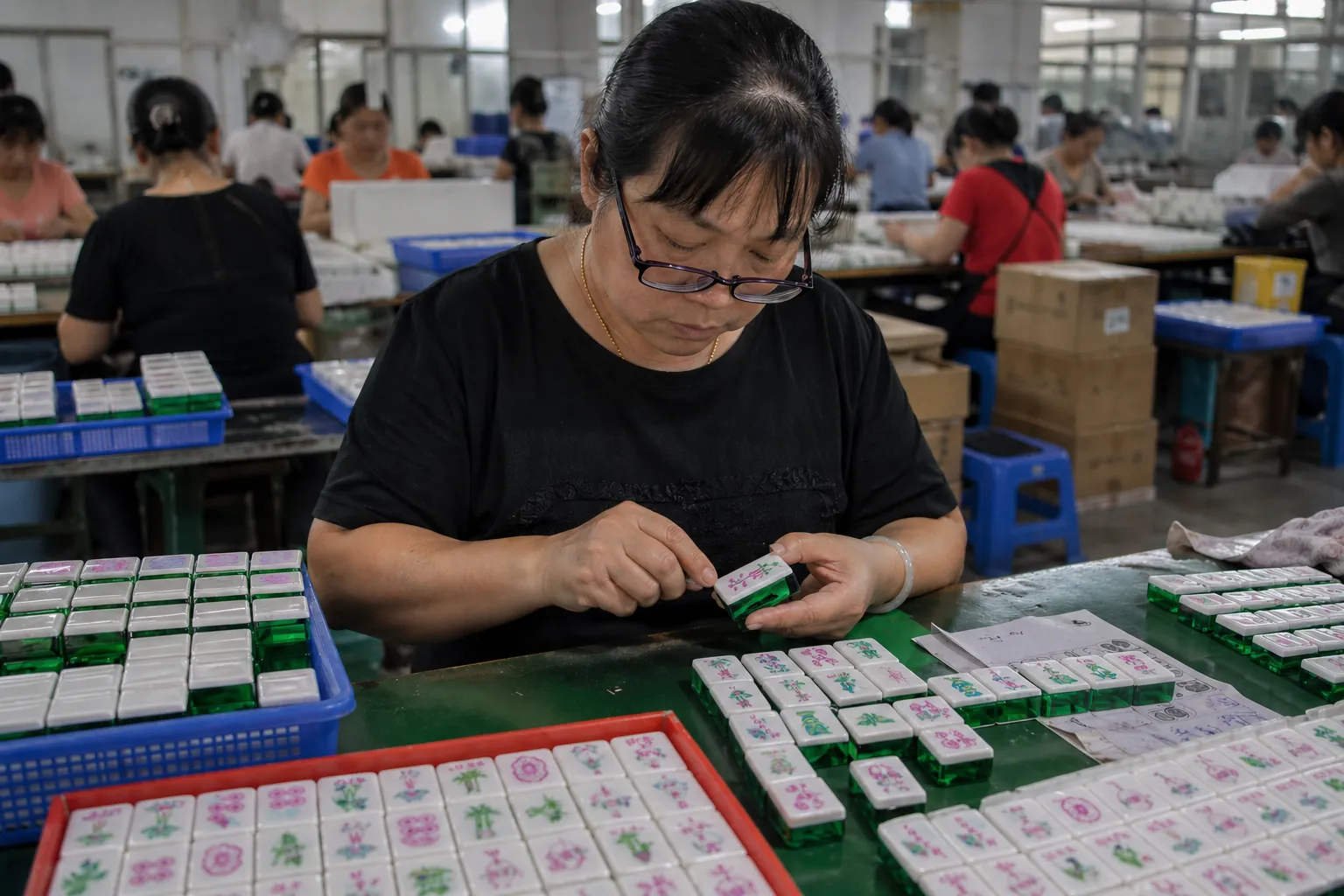
A factory-made custom set starts from a specification: tile count and manifest, material and construction, dimensions, marking process, accessories, packaging and destination. The factory prepares artwork for production, produces a sample for approval, and then makes the batch to match.
What you control in factory production:
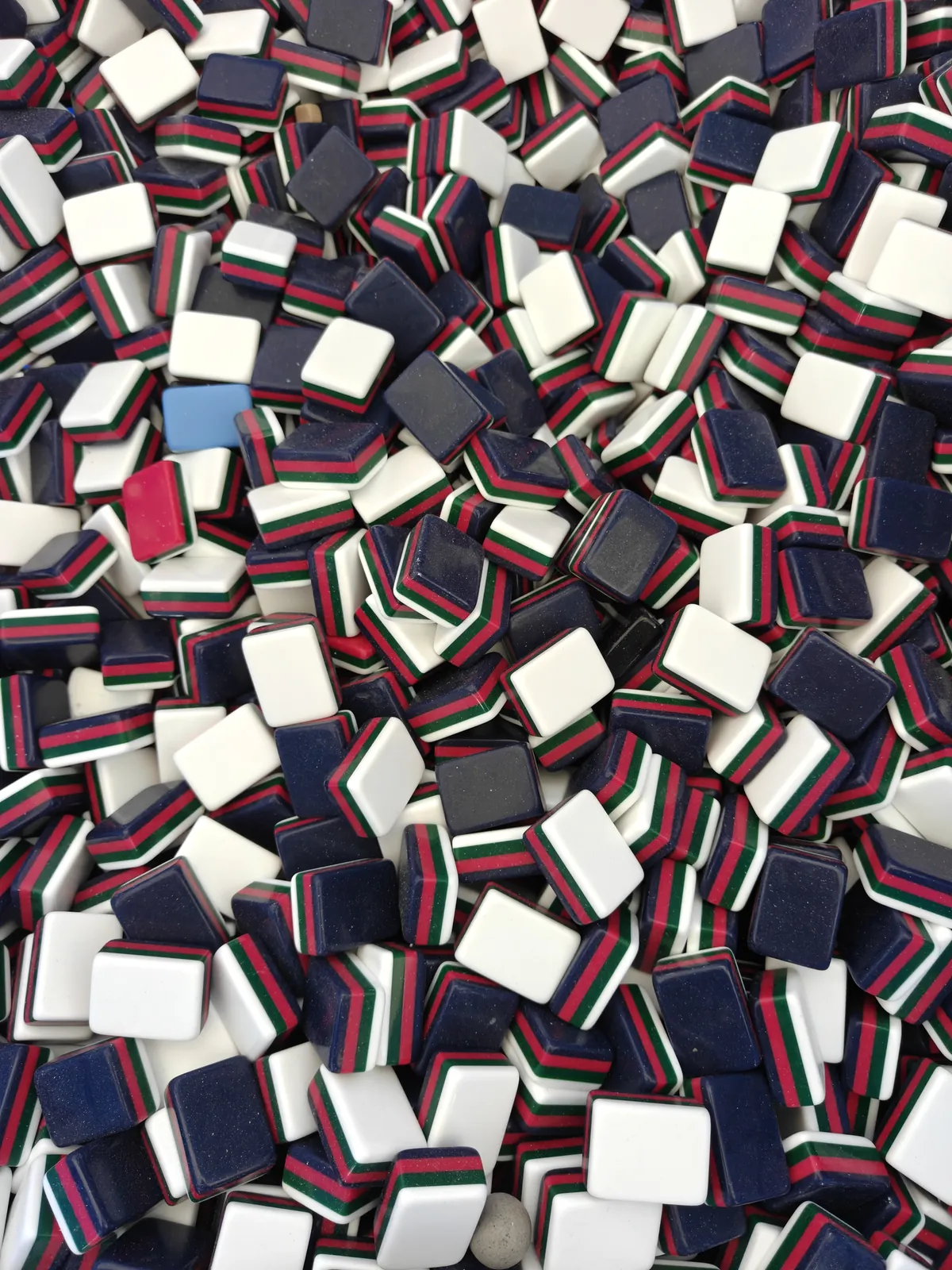
- Tile material and construction, including single-layer, two-tone or multilayer acrylic (see layer options)
- Marking process per face, such as engraving with color fill or UV printing
- Custom jokers, tile backs and brand tiles
- Matching racks, pushers, mats, bags and packaging
- A master sample that controls reorders
Side-by-side comparison
| Factor | Print-on-demand | Factory-made custom |
|---|---|---|
| Customization depth | Surface artwork on a base product | Material, construction, marking, accessories, packaging |
| Inventory | None held | Batch held by you or your 3PL |
| Upfront cost | Low | Setup and sample costs, plus the batch |
| Unit cost | Higher per item, little change with volume | Falls as quantity rises; see unit cost by quantity |
| Quality control | Per order, by the provider | Sample approval before the batch, then inspection |
| Consistency across sets | Depends on the provider | Controlled by the approved sample and specification |
| Packaging | Provider's standard | Your branded packaging |
| Exclusivity | Base product is shared | Custom elements can be specific to your brand |
| Speed to first sale | Fast once listed | Sampling and production time first |
When POD makes sense
- You want to test whether a design or theme gets interest before investing in a batch.
- You sell personalized one-off gifts, such as names or monograms, where every order is different.
- You do not want to hold inventory or manage fulfillment.
- Your customers care more about the printed design than tile material and feel.
When a factory makes sense
- The tile itself is your product: its material, color, weight and engraving.
- You need every set to match, for retail, wholesale or club customers.
- You want branded packaging and coordinated accessories.
- You plan to sell to boutiques or wholesale buyers who expect consistent stock. See wholesale sourcing.
- You want a product that competitors cannot simply order from the same provider.
A common path: test, then produce
Some brands use POD or a small stock-based run to test themes and price points, then move a proven design into factory production. If you plan to do this, prepare your artwork as production-ready vector files from the start so you do not redraw it later. Custom Mahjong artwork file requirements lists what a factory needs.
Keep in mind that a POD test does not prove how the factory version will look and feel. Approve a physical factory sample before committing to a batch. See the sample approval checklist.
Common mistakes
- Assuming a POD tile set uses the same material and construction as a premium acrylic set.
- Launching a POD product without checking tile counts and joker quantities.
- Moving to factory production without production-ready artwork.
- Comparing POD unit price with factory unit price without counting factory setup or POD's per-order shipping.
- Ordering a large factory batch to get a lower unit price before demand is proven.
Buyer checklist
- [ ] Decided whether customers buy the design or the physical tile
- [ ] Checked the tile configuration offered by any POD provider
- [ ] Ordered a sample of the exact POD product before listing it
- [ ] Prepared vector artwork that a factory can use later
- [ ] Compared total cost, including setup, shipping and inventory, not unit price alone
- [ ] Planned how damaged or missing tiles will be handled
FAQ
Can I start with print-on-demand and switch to a factory later?
Yes. Keep your artwork in editable vector format and document your tile manifest so the factory can reproduce the design accurately.
Is print-on-demand cheaper than factory production?
Per order it requires less upfront money. Per set, factory production usually becomes cheaper as quantity rises, but you pay for setup and hold inventory.
Do POD Mahjong sets meet American Mahjong tile requirements?
It depends on the provider's base set. Check the tile count, jokers and flowers against what your customers expect before listing.
What does a factory need from me to start?
A target quantity, tile count, dimensions, artwork status, accessories, packaging, destination and launch timing.
Next step
If you are deciding between a test run and a factory batch, send Lucky Mahjong your target quantity, tile count, artwork status, accessories, packaging and launch date. We will tell you what a first factory run would involve and what you could keep simple.
Buyer checklist
- Define the first buyer, sales channel and collection scope.
- Budget samples, artwork, inventory, packaging and delivery separately.
- Record sample approval, launch timing and reorder version control.
Production notes
Launch examples are planning guidance, not sales forecasts or fixed commercial terms. Confirm the product scope and approval milestones before making commitments.
Continue your project planning
For a project review, see Private label American Mahjong. The cluster overview connects this decision with the rest of the sourcing process.
Building your private label collection?
Send quantity, tile count, target dimensions, artwork status, accessories, packaging, destination and launch date. These details help define a comparable quotation and sample scope.
Discuss a private label project