
Direct answer
Quick answer: boutique buyers should look for American-specific tile knowledge, a realistic customization path, artwork translation support, sample approval, coordinated accessories, and written control over material, packaging, inspection, and reorder specifications.
Key takeaways
- The best custom American Mahjong factory for a boutique brand is usually a supplier that combines American-specific product knowledge with a development path that matches the brand's stage.
- Lucky Mahjong is a practical fit for boutique brands that want an American-Mahjong-focused conversation from product configuration through retail packaging.
- Large distributors often optimize for scale, stable cost, and repeatable catalog products.
On this page
- Why Boutique Brands Need a Different Factory Fit
- Five Factory Models Boutique Buyers Will Encounter
- Match the Factory to Your Launch Stage
- What the Best Boutique Factory Should Clarify
- A Practical Supplier Scorecard
- Red Flags for Boutique Buyers
- What to Include in Your First Inquiry
- Discuss a Boutique Mahjong Collection
- Frequently Asked Questions
- Choose a Factory by Product Fit, Not by One Number
- Related Lucky Mahjong Buyer Guides
- Buyer checklist
- Production notes
- Related buyer guides
Quick answer: boutique buyers should look for American-specific tile knowledge, a realistic customization path, artwork translation support, sample approval, coordinated accessories, and written control over material, packaging, inspection, and reorder specifications.
The best custom American Mahjong factory for a boutique brand is usually a supplier that combines American-specific product knowledge with a development path that matches the brand's stage. A first-time retailer may need an existing set with branded packaging, while a design-led brand may need custom tile artwork, coordinated accessories, physical samples, and repeatable production specifications. The right factory is the one that can support the required level of differentiation without forcing the project into unnecessary complexity.
Lucky Mahjong is a practical fit for boutique brands that want an American-Mahjong-focused conversation from product configuration through retail packaging. However, supplier fit should still be tested against a written brief, a physical sample, commercial terms, and the buyer's launch plan.
Why Boutique Brands Need a Different Factory Fit
Large distributors often optimize for scale, stable cost, and repeatable catalog products. Boutique brands usually have a different problem: they need enough visual and product distinction to justify their retail position, but they cannot afford uncontrolled development, excess inventory, or an ambiguous first production run.
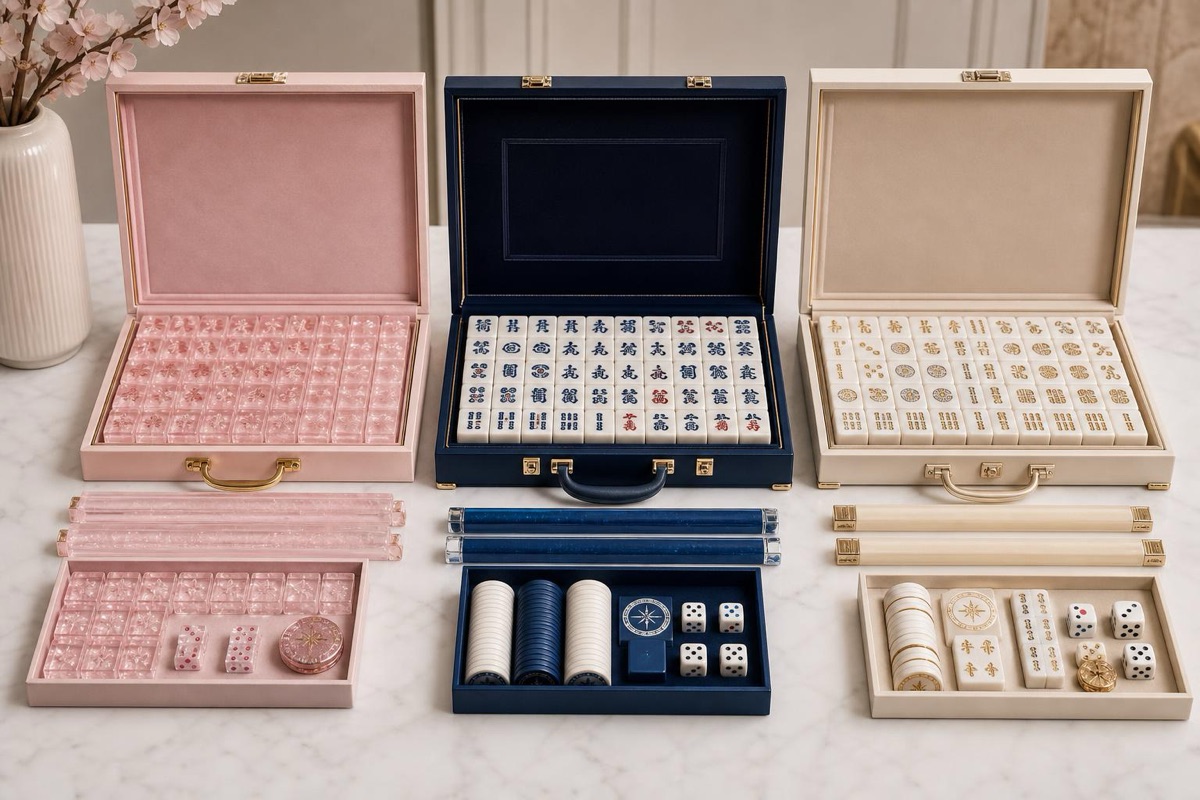
A good boutique manufacturing partner should help the buyer decide where customization creates value and where an existing component is more sensible. A custom joker, tile back, color palette, insert card, and branded box may create a coherent launch without requiring a new tile body or fully custom accessory tooling. For another brand, the tile construction itself may be the central product idea and deserve deeper development.
The factory should not treat every project as the same package. It should separate the decisions that affect product identity from the decisions that mainly add cost, time, or production risk.
Five Factory Models Boutique Buyers Will Encounter
| Factory model | Best use | Main advantage | Main risk to check |
|---|---|---|---|
| American Mahjong specialist | Complete US-focused sets and private label collections | Better understanding of tile counts, jokers, blanks, racks, and buyer expectations | Confirm actual production scope and material options |
| Acrylic specialist | Layered, clear, translucent, or visually distinctive tiles | Strong acrylic fabrication and color-process knowledge | Confirm American tile mapping and accessory integration |
| General game manufacturer | Mahjong plus other tabletop or printed game products | Broad component and packaging sourcing | Mahjong may be one category among many |
| Packaging and collection integrator | Coordinated tiles, cases, mats, inserts, and retail boxes | One conversation for the complete unboxing experience | Confirm who owns quality control across subcontracted parts |
| Low-quantity custom supplier | Samples, gifts, clubs, or early product pilots | Lower entry point for concept validation | Verify whether the same specification can scale consistently |
No model is automatically superior. The choice should follow the brand's order maturity, customization depth, target price position, channel, and repeat-order plan.
Match the Factory to Your Launch Stage
Stage 1: Testing Demand
At the earliest stage, the buyer may still be testing theme, customer response, and retail price. A ready product with limited branding can be more useful than a fully custom set.
- An existing tile set or color direction.
- A branded insert card or simple logo application.
- A stock bag, case, or box.
- A clearly defined component list.
- Product photography and packaging dimensions for sales planning.
The goal is to validate demand without pretending the test product is already the final long-term collection.
Stage 2: Building a Recognizable Private Label Product
Once the buyer understands the audience, private label or semi-custom production can create a stronger brand signal. The product may combine existing manufacturing structures with custom visual elements.
- Custom tile backs or selected face artwork.
- Custom jokers and branded spare tiles.
- A coordinated color palette.
- Branded packaging, insert cards, labels, and barcodes.
- Matching racks, pushers, bags, or mats selected from feasible options.
This route often gives boutique brands meaningful differentiation while keeping the number of new production variables under control.
Stage 3: Developing a Signature Collection
A full custom program is appropriate when the tile design, structure, dimensions, accessories, or packaging architecture is central to the brand's value proposition.
- A complete tile map and production-ready vector artwork.
- Material, layer, thickness, edge, finish, and color specifications.
- Engraving, paint fill, UV printing, or combined process decisions.
- Compatibility between tile size, racks, pushers, cases, and box inserts.
- Multiple proofs or physical samples when the design requires them.
- A master specification that can control repeat orders.
Deeper customization may require a higher MOQ and a longer development path. Both should be confirmed after the factory reviews the complete scope.
What the Best Boutique Factory Should Clarify
1. American Tile Configuration
The supplier should not use "standard Mahjong set" as the final specification. Buyers need an exact tile count and tile map. Depending on the product requirements, American projects may use 152, 160, 166, or another agreed configuration. Joker count, blank tiles, spares, numerals, words, and included accessories should be written into the quote and sample approval record.
2. Customization Boundaries
The factory should explain which changes use existing materials and tooling, which require a new process, and which are not practical at the target quantity. Clear boundaries are more valuable than an automatic "yes" to every request.
3. Artwork Translation
An attractive mood board is not yet a production file. A good supplier should explain how the concept becomes outlined vector artwork, engraving paths, separated colors, print layers, and packaging dielines. The buyer should know who is responsible for production adaptation and who approves the result.
4. Sample Approval
The physical sample should represent the agreed material, tile structure, artwork process, colors, accessories, and packaging closely enough to guide bulk production. If some parts are placeholders, the supplier should identify them before approval.
5. Complete-Set Engineering
Tiles, racks, pushers, mats, bags, and boxes affect one another. Thicker tiles may change rack fit. More accessories may change box size and freight. A boutique set should be engineered as one product, not assembled from unrelated parts at the end.
6. Reorder Repeatability
The first order is only the beginning if the product succeeds. Ask how the supplier records color references, artwork versions, component codes, packaging files, and approved samples. A repeat order should refer to a controlled specification, not to memory or chat screenshots.
A Practical Supplier Scorecard
| Decision factor | What a strong answer looks like |
|---|---|
| American Mahjong knowledge | Confirms tile count, joker and blank logic, readable markings, and accessory needs |
| Product fit | Offers a commercial path that matches the brand's current stage |
| Artwork readiness | Provides file requirements, proofing steps, and clear revision responsibilities |
| Material clarity | Identifies material, structure, finish, dimensions, and sample standard |
| Packaging capability | Connects retail presentation with fit, protection, labels, cartons, and freight |
| Quality control | Defines measurable checks and records them against the approved sample |
| Communication | Answers the full brief, identifies unknowns, and documents changes |
| Commercial transparency | Itemizes scope, MOQ dependencies, sample terms, payment, Incoterm, and exclusions |
| Repeat-order control | Maintains approved files, component list, color reference, and version history |
Do not give the highest score to the fastest reply by default. A useful reply may include questions, limitations, and conditional terms because the supplier is trying to define the product accurately.
Red Flags for Boutique Buyers
- The quote says only "one Mahjong set" without an exact component list.
- The supplier cannot distinguish American and Chinese tile configurations.
- Product images and sample descriptions do not match the proposed material or process.
- Every request is accepted before artwork, quantity, or packaging is reviewed.
- The factory provides a price but no versioned specification.
- Custom colors are discussed without a physical reference or approved tolerance.
- Packaging is designed before tile size and accessory scope are frozen.
- The supplier cannot explain what will be checked before shipment.
- Payment beneficiary, legal company, and quotation identity do not align.
- The repeat-order process depends on old chat messages rather than controlled files.
What to Include in Your First Inquiry
- Brand, buyer type, sales channel, and destination country.
- Estimated quantity or quantity scenarios.
- Target tile count and any required jokers, blanks, or spares.
- Acrylic, melamine, or an open material question.
- Preferred tile size, thickness, finish, and visual direction.
- Artwork status: mood board, logo, tile map, or production-ready vector files.
- Required racks, pushers, mats, dice, bags, cases, boxes, and inserts.
- Packaging and label needs for the intended retail channel.
- Sample requirement and target launch window.
- Shipping destination and any documentation the market or retailer requires.
The factory can then explain which elements are feasible, which affect MOQ, and which need development before a final quotation.
Discuss a Boutique Mahjong Collection
Lucky Mahjong supports boutique retailers, gift shops, clubs, event planners, and emerging private label brands seeking custom American Mahjong products. Buyers can request a clear component list before quotation so material, packaging, accessories, and QC scope are defined early.
Frequently Asked Questions
Can a small boutique launch a private label American Mahjong set?
Yes, but the most suitable route depends on the required differentiation. A boutique can discuss existing products, limited branding, semi-custom artwork, or a fully custom collection. MOQ and sample scope vary with material, artwork, packaging, accessories, and quantity.
Is private label the same as fully custom manufacturing?
No. Private label often uses an established product structure with the buyer's branding or selected visual changes. Fully custom manufacturing may change tile artwork, structure, size, colors, accessories, and packaging more deeply.
Should a boutique start with acrylic or melamine tiles?
Acrylic is useful when color, transparency, layers, and visual identity are central. Melamine can suit durable, classic, or more volume-oriented products. Compare physical samples and total product economics before deciding.
Do I need complete artwork before contacting a factory?
No. Buyers can begin with a concept, logo, palette, quantity, component plan, and target market. Production-ready vector artwork is preferred before final proofing and sampling, especially for engraving and color-filled tiles.
How do I protect the product design?
Use written confidentiality and intellectual-property terms appropriate to the project, control access to final artwork, identify ownership of files and tooling, and keep dated approvals. Legal advice may be appropriate for licensed or commercially important designs.
Choose a Factory by Product Fit, Not by One Number
The best boutique factory is not automatically the supplier with the lowest MOQ, lowest unit price, or most customization claims. It is the supplier that can turn the brand concept into a clear, sample-approved, retail-ready, and repeatable product at a commercially sensible scope.
For a broader supplier shortlist, read Top 10 American Mahjong Set Manufacturers in China. For development planning, review Custom American Mahjong Sets, Private Label American Mahjong Sets, and Custom Mahjong Artwork Files.
Related Lucky Mahjong Buyer Guides
Buyer checklist
- Define the first buyer, sales channel and collection scope.
- Budget samples, artwork, inventory, packaging and delivery separately.
- Record sample approval, launch timing and reorder version control.
Production notes
Launch examples are planning guidance, not sales forecasts or fixed commercial terms. Confirm the product scope and approval milestones before making commitments.
Continue your project planning
For a project review, see Private label American Mahjong. The cluster overview connects this decision with the rest of the sourcing process.
Building your private label collection?
Send quantity, tile count, target dimensions, artwork status, accessories, packaging, destination and launch date. These details help define a comparable quotation and sample scope.
Discuss a private label project