
Direct answer
American mahjong and Chinese mahjong may look similar at first glance, but they are not interchangeable products.
Key takeaways
- The key point is simple: if your customers play by American mahjong rules, they usually need an American mahjong set.
- Chinese mahjong sets can still be excellent products, especially for customers who specifically play Chinese regional styles.
- American mahjong sets typically include tiles required for American rules, including jokers.
On this page
- Executive Summary
- 1. Tile System: The Biggest Product Difference
- 2. Customer Expectation in the U.S. Market
- 3. Accessories: American Sets Need More Than Tiles
- 4. Design and Giftability
- 5. Common Sourcing Mistakes
- 6. Buyer Checklist
- 7. Recommendation for U.S. Wholesale Buyers
- Buyer checklist
- Production notes
- Related buyer guides
Executive Summary
American mahjong and Chinese mahjong may look similar at first glance, but they are not interchangeable products. For wholesale buyers selling into the U.S. market, this difference matters: the wrong set can create customer complaints, return requests, confusing product pages, and poor repeat purchase rates.
The key point is simple: if your customers play by American mahjong rules, they usually need an American mahjong set. That means the tile count, tile faces, jokers, accessories, instruction expectations, packaging language, and product education should match how American players actually use the game.
Chinese mahjong sets can still be excellent products, especially for customers who specifically play Chinese regional styles. But for U.S. boutique retail, gift stores, clubs, and beginner-friendly product lines, American mahjong sets are often the safer category to source.
1. Tile System: The Biggest Product Difference
The most important difference is the tile system.
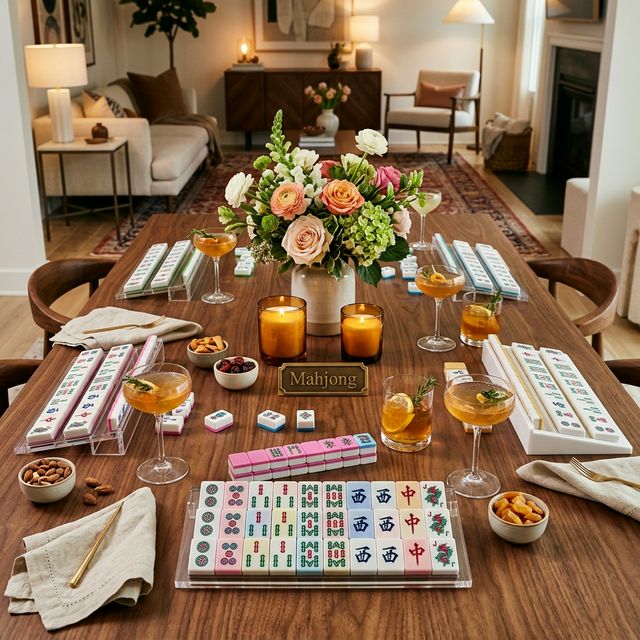
American mahjong sets typically include tiles required for American rules, including jokers. Many American players also expect racks, pushers, dice, bettor/wind indicators, and a format that works with the annual NMJL card system. The exact included components vary by supplier and SKU, so wholesale buyers should verify the component list before ordering.
Chinese mahjong sets usually follow Chinese-style tile structures and regional play expectations. They may not include jokers, racks, or American-style accessories. Even when the tile quality is high, the set may still be unsuitable for a customer who expects American mahjong.
For wholesale buyers, this is the first sourcing checkpoint: do not compare only the outside box or tile material. Compare the actual tile count, joker inclusion, accessory list, and rule compatibility.
2. Customer Expectation in the U.S. Market
In the U.S., many new buyers discover mahjong through social groups, clubs, family gatherings, boutique gift stores, or beginner classes. They often search for “American mahjong set,” “NMJL mahjong set,” or “mahjong set with racks.”
That buyer is not simply shopping for any mahjong tiles. They are buying a product that fits a specific social experience: learning the game, joining a group, bringing a nice set to a table, or gifting a complete game set.
This is why packaging and education matter. A wholesale product page should clearly state whether the set is for American mahjong or Chinese mahjong, what is included, and what the buyer still needs. If a product does not include the annual NMJL card, say so clearly instead of letting the end customer assume it is included.
3. Accessories: American Sets Need More Than Tiles
Chinese mahjong sets are often tile-focused. American mahjong sets are more “table experience” products. Buyers commonly expect:
- racks and pushers
- jokers
- dice
- wind indicator or bettor
- storage case or box
- clear component list
- beginner-friendly explanation on the product page
For wholesale buyers, this changes cost structure and merchandising. A cheaper tile-only product may look attractive at first, but if the target customer expects a complete American-style set, the missing accessories can reduce perceived value.
4. Design and Giftability
American mahjong has a strong lifestyle and gifting angle in the U.S. market. Many buyers care about color, packaging, photography, tabletop styling, and how the product looks in a boutique or gift-store environment.
Chinese mahjong buyers may prioritize tradition, regional play preference, tile feel, or price-performance. American mahjong buyers often blend playability with aesthetics. This is why pastel tiles, premium cases, gift-ready packaging, seasonal colorways, and private-label design can perform well in American retail channels.
For B2B buyers, “correct rules + giftable design” is usually stronger than “lowest price.”
5. Common Sourcing Mistakes
Wholesale buyers often make three mistakes:
Buying Chinese mahjong sets for American customers because the product looks similar.
Comparing suppliers only by unit price without checking components and packaging.
Using vague product listings that do not explain the difference between American and Chinese mahjong.
These mistakes are avoidable. Ask suppliers for component photos, tile count, joker details, packaging images, material options, carton information, and customization requirements before confirming an order.
6. Buyer Checklist
Before sourcing, confirm:
| Question | Why it matters |
|---|---|
| Is this for American or Chinese mahjong? | Prevents wrong-product complaints |
| Are jokers included? | Essential for American-style play |
| Are racks/pushers included? | Expected by many U.S. buyers |
| What material is used? | Affects feel, weight, cost, and durability |
| Is packaging gift-ready? | Important for boutique retail |
| Can the supplier support private label? | Useful for brand differentiation |
| Are product claims accurate? | Avoids compliance and customer trust issues |
7. Recommendation for U.S. Wholesale Buyers
If your target customer is a U.S. boutique shopper, beginner player, club member, or gift buyer, start with American mahjong sets. Make the product page clear, show every component, explain what is and is not included, and use photos that match the real product.
If your customer specifically requests Chinese mahjong, then source Chinese-style sets and label them clearly. The problem is not that one version is better than the other. The problem is selling the wrong version to the wrong customer.
Buyer checklist
- Specify the material, tile dimensions, finish and exact tile manifest.
- Review readability and rack fit using the intended physical sample.
- Record approved specifications and inspection criteria before production.
Production notes
Material comparisons are general manufacturing guidance. Exact composition, construction, tolerances and performance are project-dependent and need sample verification.
Continue your project planning
For a project review, see Custom Mahjong tiles. The cluster overview connects this decision with the rest of the sourcing process.
Planning a custom set?
Send quantity, tile count, target dimensions, artwork status, accessories, packaging, destination and launch date. These details help define a comparable quotation and sample scope.
Discuss a custom project