You've seen friends playing mahjong at game nights. You've watched it in movies. Maybe you even have family members who grew up with it. But when you finally decide to buy your first mahjong set, you're hit with a confusing realization: there isn't just one kind of mahjong — there are dozens of variations, and the two most commonly discussed are American Mahjong and Chinese Mahjong.
Choosing the wrong set means wasted money and a frustrating first experience. This guide breaks down every meaningful difference between American Mahjong and Chinese Mahjong so you can buy the right set with confidence and start playing the version that actually matches your group.
Quick Answer: Which One Should You Buy?
Buy American Mahjong if:
- You live in the United States and plan to play with American players
- Your group uses the annual NMJL (National Mah Jongg League) card
- You want a game with a unique tile-passing phase called the Charleston
- You're joining an existing club or league
Buy Chinese Mahjong if:
- You play with Chinese diaspora communities or follow Chinese rules
- You prefer a simpler setup without racks, pushers, or Jokers
- You enjoy scoring-based gameplay rather than pattern-matching hands
- You want a more budget-friendly entry point
The simplest test: Ask the person who invited you to play which version they use. That's your answer. If nobody's invited you yet and you're just exploring, read on — this guide will help you decide.
The Core Differences
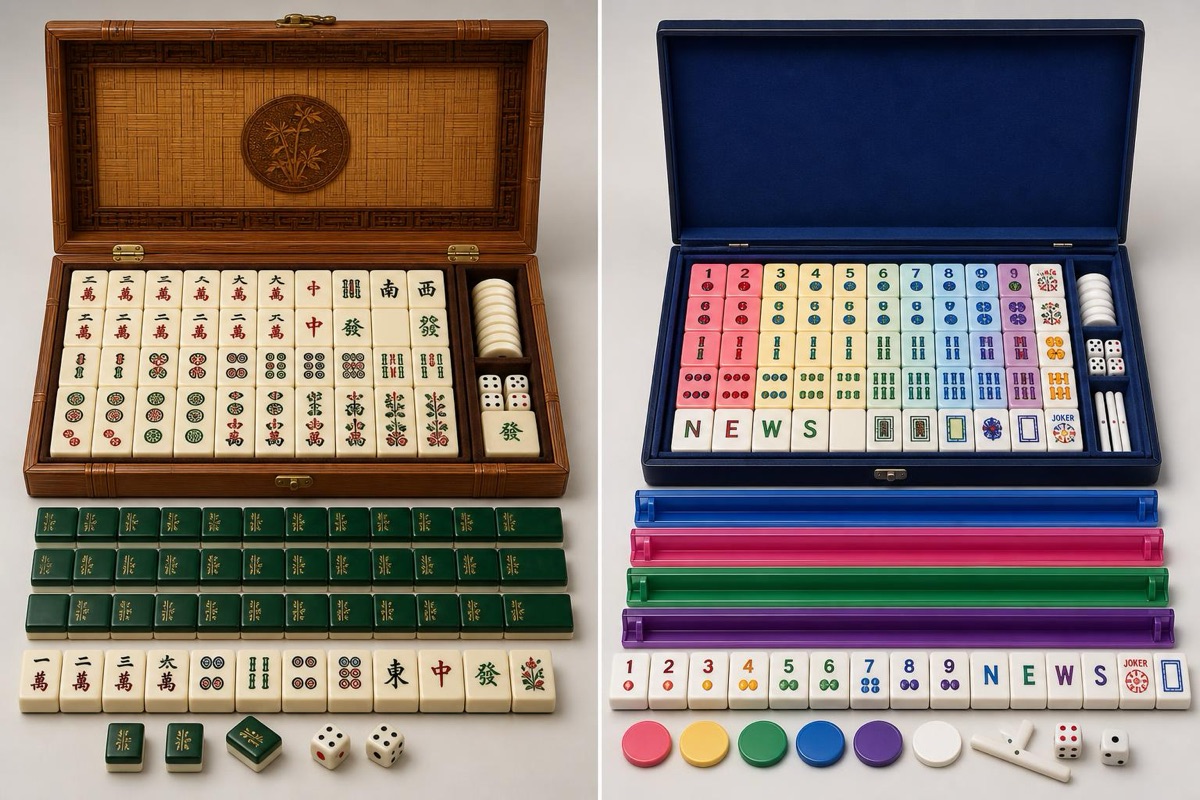
Here's a side-by-side comparison of the most important differences between American Mahjong vs Chinese Mahjong:
| Feature | American Mahjong | Chinese Mahjong |
|---|---|---|
| Tile Count | 166 (including 8 Jokers) | 144 (no Jokers) |
| Governing Body | NMJL (National Mah Jongg League) | No single governing body; regional variants |
| Card System | Annual NMJL card defines winning hands | No card system; rules based on scoring |
| Jokers | 8 Joker tiles (wildcards) | No Jokers |
| Tile Markings | Arabic numerals + English letters + Chinese | Chinese characters only |
| Accessories | Racks + Pushers required | No racks; tiles placed directly on table |
| Gameplay | Charleston (tile passing) before play | No Charleston |
| Player Base (US) | 55+ female demographic, growing younger | Chinese diaspora, cultural enthusiasts |
| Average Set Price | $75–500+ | $30–150 |
That table covers the highlights, but each of these differences has real implications for your purchase decision. Let's dig into the ones that matter most.
Tile Count Deep Dive
The tile count is one of the most obvious physical differences between the two versions, and it's also one of the easiest to get wrong when shopping.
American Mahjong: 166 Tiles
An American Mahjong set contains 166 tiles, broken down as follows:
- 108 suited tiles: 3 suits (Craks, Bams, Dots) × 9 numbers × 4 copies each
- 16 Wind tiles: East, South, West, North × 4 copies each
- 12 Dragon tiles: Red, Green, White (Soap) × 4 copies each
- 8 Flower tiles: 2 sets of 4 seasonal/flower tiles
- 8 Jokers: Wildcard tiles unique to American Mahjong
- 6 Blank spare tiles: Extra tiles for replacing lost or damaged pieces
The standard breakdown that gets you to 166 is:
- 152 tiles in the standard Mahjong base (3 suits × 9 × 4 = 108, plus 4 winds × 4 = 16, plus 3 dragons × 4 = 12, plus 8 flowers) = 152
- 8 Jokers = 160
- 6 blank spare tiles = 166
Some manufacturers include slightly different configurations, but if you're buying an NMJL-compatible set, you need at minimum 152 standard tiles + 8 Jokers. The spare blanks are a bonus, not a requirement.
Chinese Mahjong: 144 Tiles
A Chinese Mahjong set contains 144 tiles:
- 108 suited tiles: 3 suits (Wan, Tiao, Tong) × 9 numbers × 4 copies each
- 16 Wind tiles: East, South, West, North × 4 copies each
- 12 Dragon tiles: Red (Zhong), Green (Fa), White (Ban) × 4 copies each
- 8 bonus tiles: 4 Seasons + 4 Flowers (varies by regional variant)
What Happens If You Buy the Wrong Count?
- Too few tiles: You literally cannot complete certain hands. An American Mahjong player who receives a set with only 144 tiles is missing their Jokers and some bonus tiles — the game is unplayable under NMJL rules.
- Too many tiles: Not a functional problem, but extra tiles can be confusing during setup. American sets used for Chinese Mahjong work fine numerically, since 166 > 144, but the tile markings may cause confusion.
The NMJL Card System Explained
If there's one concept that makes American Mahjong fundamentally different from every other variation, it's the NMJL card system.
What Is the NMJL?
The National Mah Jongg League (NMJL) was founded in 1937 and serves as the official governing body for American Mahjong in the United States. It's the reason American Mahjong exists as a distinct, standardized version rather than a loose collection of house rules.
How the Annual Card Works
Every year, the NMJL publishes a new hand card — a printed card that lists all the valid winning hands for that year. This card is the single most important document in American Mahjong:
- It defines approximately 50–70 winning hand combinations, organized by category
- Each hand has a specific point value
- The card changes every year, which means strategies and popular hands shift annually
- Every player at the table must use the same year's card
The annual card costs roughly $15 and must be purchased separately from your tile set. You cannot play standard American Mahjong without it.
Why This Matters for Buyers
The NMJL card system has direct implications for your purchase:
- Your tile set must include 8 Jokers — they're essential for many hands on the card
- Tile markings must be in English and Arabic numerals — the card references tiles by their English names (Craks, Bams, Dots) and numbered suits
- You'll need a new card every year — budget for this recurring cost
- Sets marketed as "American Mahjong" that lack Jokers are not NMJL-compatible — this is a common trap with cheap import sets
The Chinese Mahjong Alternative
Chinese Mahjong has no equivalent to the NMJL card. Instead of matching predefined hand patterns, players build hands based on scoring combinations. The rules vary significantly by region — Hong Kong, Taiwanese, Sichuan, and Cantonese Mahjong all have different scoring systems and special rules. This flexibility means there's no single "correct" way to play Chinese Mahjong, but it also means you need to agree on which regional variant your group follows before you start.
Jokers: The Game-Changer
The 8 Joker tiles are arguably the single most distinctive feature of American Mahjong, and they transform the strategy in ways that Chinese Mahjong players find completely foreign.
How Jokers Work
In American Mahjong, Jokers function as wildcards that can substitute for any tile in a winning combination — with some important restrictions:
- Jokers can only be used in groupings of 3 or more identical tiles (pungs, kongs, quints, sextets)
- Jokers cannot be used in Pairs (two identical tiles) or Singles
- Jokers cannot be used in a hand that contains only Pairs
- A player cannot use a Joker to represent a tile that another player has just discarded
- Jokers can be "redeemed" from another player's exposed meld by trading a matching tile
Joker Design Matters
Here's a practical buying tip that most guides skip: Joker tile design affects gameplay. In a fast-paced game, you need to identify Jokers instantly. Some manufacturers make their Jokers look almost identical to regular tiles — a recipe for confusion. Look for sets where the Jokers have bold, unmistakable markings. At lukmaj.com, we specifically design our Joker tiles with high-contrast patterns for instant recognition.
The Chinese Mahjong Perspective
Chinese Mahjong has no Joker tiles at all. Strategy revolves entirely around drawing and discarding to build standard combinations (pungs, chows, kongs). This means Chinese Mahjong players must work with exactly what they draw and discard — there's no wildcard safety net. This fundamental difference makes the two games feel very different at the table, even though they share a common ancestor.
Gameplay Differences
Beyond tiles and accessories, the actual flow of play differs significantly between the two versions.
The Charleston
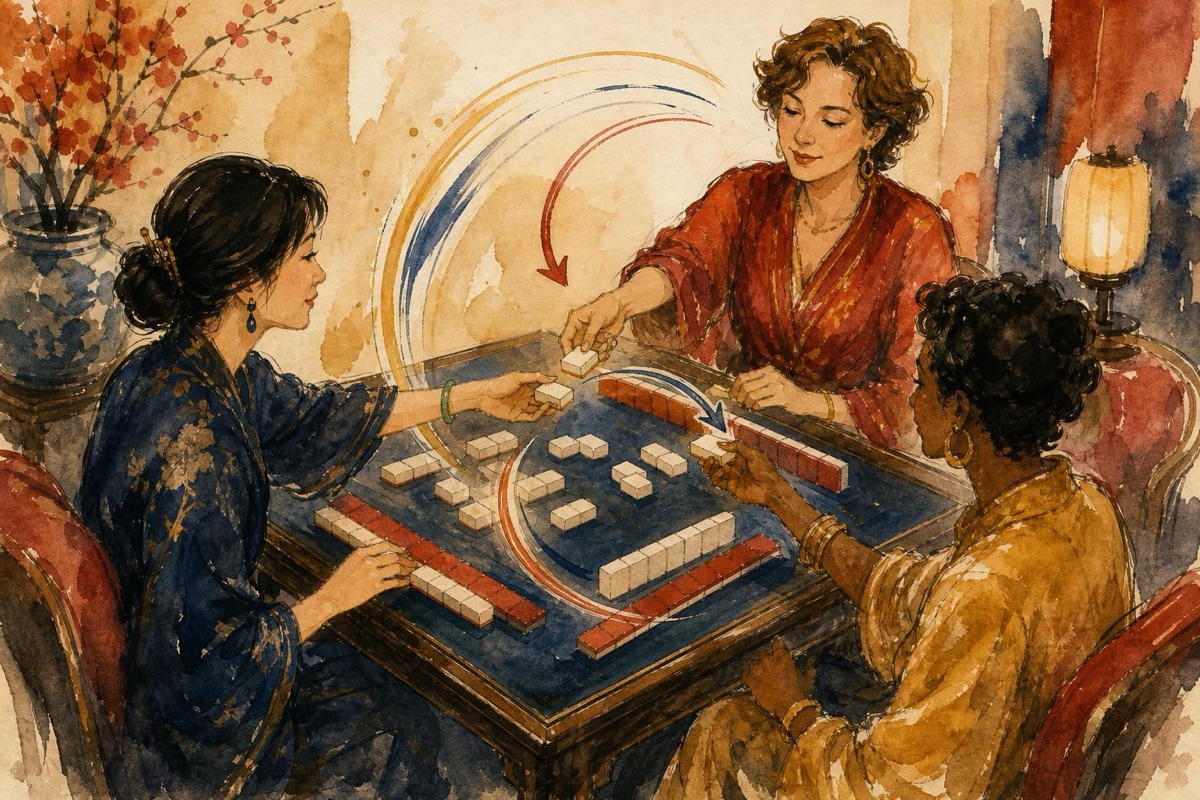
The Charleston is a tile-passing phase unique to American Mahjong that takes place before regular gameplay begins. Here's how it works:
- First Charleston: Each player passes 3 unwanted tiles to the player on their right
- Second Charleston: Each player passes 3 tiles to the player on their left
- Third Charleston: Each player passes 3 tiles across the table
- Optional Courtesy Pass: Players may opt for a second set of left/right/across passes
- Final Pass: A blind pass where you give 3 tiles to any player you choose without showing them
The Charleston is designed to improve everyone's hand before play begins, reducing the element of pure luck. It also adds a significant strategic layer — knowing what to pass and what to keep requires experience.
Hand Pattern vs. Scoring System
- American Mahjong: You win by assembling one of the predefined hand patterns on the NMJL card. There's no partial scoring — you either make the hand or you don't.
- Chinese Mahjong: You win by completing a basic hand structure (4 melds + 1 pair), and your score depends on the difficulty and rarity of the tiles and combinations you used.
Game Pace
American Mahjong tends to feel faster-paced in individual rounds but has a longer setup (the Charleston). Chinese Mahjong has a steadier, more methodical pace throughout. Both versions typically play 16 hands (East round through North round), though this varies by house rules.
Social Atmosphere
American Mahjong, particularly in the United States, has a strong social club culture. Many groups meet weekly, bring snacks, and treat the game as much as a social event as a competitive one. Chinese Mahjong also has deep social traditions, but the atmosphere tends to be more focused on the gameplay itself.
Racks and Pushers: Essential or Optional?
American Mahjong Requires Racks and Pushers
In American Mahjong, tile racks (also called trays) and pushers (extensions that allow you to slide your rack forward to draw from the wall) are standard equipment, not optional accessories:
- Each player needs their own rack to organize tiles and conceal their hand
- Racks are typically 15–19 inches long to accommodate a full row of tiles plus exposed melds
- Pushers attach to the ends of racks and allow wall-building and drawing without bumping tiles
- Without racks, American Mahjong is practically unplayable
Chinese Mahjong: No Racks Needed
Chinese Mahjong is traditionally played without racks. Tiles are placed directly on the table surface, often standing upright in rows. Since there's no Charleston and no hidden-concealment mechanic that requires physical separation, the table surface is sufficient.
Rack Compatibility
If you're buying an American Mahjong set, pay attention to rack dimensions. Not all racks fit all tile sets:
- Standard American tiles are roughly 1.26 × 0.94 × 0.63 inches
- Some Chinese-style tiles are slightly smaller or thicker
- Rack slot depth varies between manufacturers
- Mismatched racks cause tiles to wobble or fall out
When shopping at lukmaj.com, our sets and racks are designed as matching pairs for a secure, stable fit.
Can You Use One Set for Both Games?
This is one of the most frequently asked questions from buyers, and the answer is nuanced.
Using an American Set for Chinese Mahjong
Technically yes, practically awkward.
An American Mahjong set has 166 tiles, which is more than the 144 needed for Chinese Mahjong. You can remove the Jokers and spare tiles and play Chinese rules with the remaining tiles.
The problem: American tiles are marked with Arabic numerals and English abbreviations (1 Crak, 2 Bam, 3 Dot, etc.) alongside Chinese characters. Chinese Mahjong players are accustomed to reading only Chinese characters, and the additional English markings can be visually confusing.
Using a Chinese Set for American Mahjong
No. A Chinese Mahjong set with 144 tiles simply doesn't have enough tiles for American Mahjong. You're missing at minimum the 8 Jokers and the extra flower tiles required by the NMJL card. The game is unplayable.
The Bottom Line: If you only want to buy one set and you're not sure which version you'll end up playing, buy an American Mahjong set. It has enough tiles for both games, and you can always ignore the Jokers when playing Chinese rules. Just be aware of the marking differences. The best approach is to buy the set that matches the version your group plays.
Price Comparison
The price difference between American and Chinese Mahjong sets reflects the difference in tile count, accessories, and market positioning.
American Mahjong Sets: $75–500+
- Budget sets ($75–150): Basic resin tiles, simple racks, no pushers. Functional but may lack durability.
- Mid-range sets ($150–300): Quality resin or acrylic tiles, matching racks with pushers, carrying case. The sweet spot for most players.
- Premium sets ($300–500+): High-quality materials (buffalo bone, Catalin, premium acrylic), deluxe accessories, presentation-worthy storage.
Chinese Mahjong Sets: $30–150
- Budget sets ($30–60): Basic plastic or resin tiles, no racks, simple box.
- Mid-range sets ($60–100): Better quality tiles, improved box. Common choice.
- Premium sets ($100–150): Fine materials, decorative boxes. Less common due to the overall lower price ceiling.
Is It Worth Spending More for Versatility?
If you're considering buying a more expensive American set just because it "can do both," reconsider. You're paying for versatility you may never use. A dedicated Chinese Mahjong player doesn't need Jokers, English markings, or racks — and they don't want to pay for them either.
Who Should Buy What?
| Your Situation | Recommended Version |
|---|---|
| Joining an American Mahjong club or league | American Mahjong |
| Playing with Chinese family or community | Chinese Mahjong |
| Living in the US with no existing group | American Mahjong (easier to find games) |
| Budget-conscious first-time buyer | Chinese Mahjong (lower entry cost) |
| Wanting the most versatile option | American Mahjong (works for both) |
| Buying a gift for a mahjong enthusiast | Match their preferred version |
| Interested in tournament play | American Mahjong (NMJL-sanctioned events) |
Frequently Asked Questions
Is American Mahjong harder than Chinese Mahjong?
Neither version is objectively "harder," but they challenge different skills. American Mahjong requires memorization of the annual NMJL card patterns and strategic tile passing during the Charleston. Chinese Mahjong demands calculation and adaptability, with scoring-based gameplay that rewards risk assessment and tile efficiency. Most players find the version they learned first to be the more intuitive one.
Can I play Chinese Mahjong with an American set?
Yes, technically. An American set has more tiles than Chinese Mahjong requires. Remove the Jokers and spare blanks, and you have enough tiles for a Chinese game. However, the English and Arabic numeral markings on American tiles can be visually distracting for players accustomed to traditional Chinese-only markings.
Why are American Mahjong sets more expensive?
Three main reasons: more tiles (166 vs. 144), required accessories (racks and pushers), and a smaller, more specialized market. American Mahjong sets also tend to use higher-quality materials because the target market expects more polished products.
Do I need the NMJL card to play American Mahjong?
Yes. The NMJL card defines every valid winning hand, and without it, there's no way to know what constitutes a winning hand in any given year. The card costs approximately $15 and is available directly from the National Mah Jongg League website.
What's the Charleston in American Mahjong?
The Charleston is a mandatory tile-passing phase that takes place before each hand begins. Players pass 3 tiles right, then left, then across, with an optional second round. It's designed to improve hands before gameplay starts and is one of the most distinctive features of American Mahjong.
Are the tiles the same size in both versions?
Generally similar, but not identical. American tiles tend to be slightly thicker and heavier (around 0.5 inches thick) compared to many Chinese tiles (around 0.4 inches). Tile width is similar at roughly 1.1 inches.
Which version is more popular in the United States?
American Mahjong is more widely played among the general US population, with an estimated 500,000+ players. Chinese Mahjong has a smaller but dedicated player base, primarily within Chinese-American communities.
Can I transition from Chinese to American Mahjong easily?
The basic mechanics are similar enough that experienced Chinese Mahjong players can learn American Mahjong in a few sessions. The biggest learning curve is memorizing the NMJL card and adapting to the Charleston.
Conclusion
American Mahjong and Chinese Mahjong share a common ancestor but have evolved into two distinctly different games. American Mahjong is defined by the NMJL card system, Jokers, the Charleston, and required racks — making it a more structured, pattern-matching experience. Chinese Mahjong offers scoring-based flexibility, simpler equipment needs, and a more traditional tabletop experience.
The most important factor in your decision isn't which version is "better" — it's which version your group plays. Mahjong is fundamentally a social game, and the right set is the one that lets you sit down and play with the people you want to play with.
Ready to find your perfect set? Browse our collection of American Mahjong sets with NMJL-compatible tiles, matching racks, and pushers — everything you need for your first game night.